Building an AI agent that actually knows what's happening in your customers' accounts right now is a different problem than building one that works in a demo. The data freshness gap is real, the multi-tenant auth complexity is real, and the rate limit headaches are very real. Here's how to think through all of it without blowing up your roadmap.
TLDR:
- MCP tells your AI agent what tools exist and lets it act, unlike REST APIs that wait to be called
- Agents running on batch syncs will confidently give wrong answers in production, stale data is a silent killer
- Multi-tenant MCP deployments need per-tenant OAuth scoping, or one compromised key can expose every customer
- Building your own MCP server makes sense for one or two connectors, but multi-tenant auth alone takes weeks before you write any business logic
- Hotglue's Composite MCP endpoint scopes tools per tenant via a single API call, with SOC 2 Type II certification and a process-and-deliver data model
What MCP Actually Is (and Why It's Different From a REST API)
A REST API tells your app how to fetch data. MCP tells an AI agent what tools are available and how to use them, without a human writing glue code for every interaction. For most B2B SaaS teams, this lands squarely on the CPO's or Head of Partnerships' radar: it's a product decision with real engineering cost, and the person accountable for integration strategy is the one who has to make the build-vs-buy call before the roadmap fills up with auth plumbing. (Spoiler: engineering will say they can build it. They always say that.)
Anthropic launched the Model Context Protocol in November 2024 to solve what engineers call the N×M integration problem: if N AI models need to connect to M different tools, you get an explosion of custom connectors. MCP collapses that into a single standard, a shift that's reshaping B2B SaaS integrations. As WorkOS explains, MCP is purpose-built for agents. It exposes tools—not bare endpoints—so an agent can identify what actions are available and reason about which to call.
The practical difference: a REST API waits to be called. An MCP server tells the agent what's possible, then lets it act.
Why AI Agents Break Without Live Data Access
An AI agent is only as good as the data it's reasoning over. Feed it a snapshot from last night's batch sync and ask it to pull up a customer's outstanding balance, and you might get a number that was accurate 14 hours ago. For a customer on the phone right now, that's a problem.
This is the core failure mode. Agents built on static context windows or nightly ETL pipelines work fine in demos, where the data was staged an hour before the call. In production, they quietly degrade. A sales agent surfaces a renewal opportunity on an account that churned last week. A support agent confirms an order shipped when fulfillment flagged it as stuck two hours ago.
The instinct is to poll more frequently, running syncs every 15 minutes instead of every hour, a tradeoff well covered in webhooks vs. scheduled syncs. But polling has a ceiling. At high enough frequency, the overhead compounds fast across tenants, and more API calls run headlong into rate limits.
Re-prompting the user is the other workaround. "Can you confirm your current invoice total?" That question exists because the agent doesn't know. Users notice, and it breaks the entire premise of having an agent in the first place.
The deeper issue is that most integration architectures were designed for analytics pipelines, not real-time reasoning loops. Scheduled syncs into a warehouse made sense when a human was going to look at a dashboard in the morning. They were never built for an agent that needs to decide, right now, whether to issue a credit or escalate a ticket, which is exactly where AI agent MCP auth architecture starts to matter.
How MCP Works in a Multi-Tenant B2B SaaS Environment
Getting MCP working on your laptop is straightforward. You paste credentials into a .env file, define a few tools using Hotglue's developer tools, and the agent runs. Deploying that same setup across thousands of customer accounts is a completely different problem — the kind that turns a proud demo into a very humbling production incident. This is typically where the CPO schedules a calendar invite called "quick sync" and the infra team quietly updates their LinkedIn profiles.
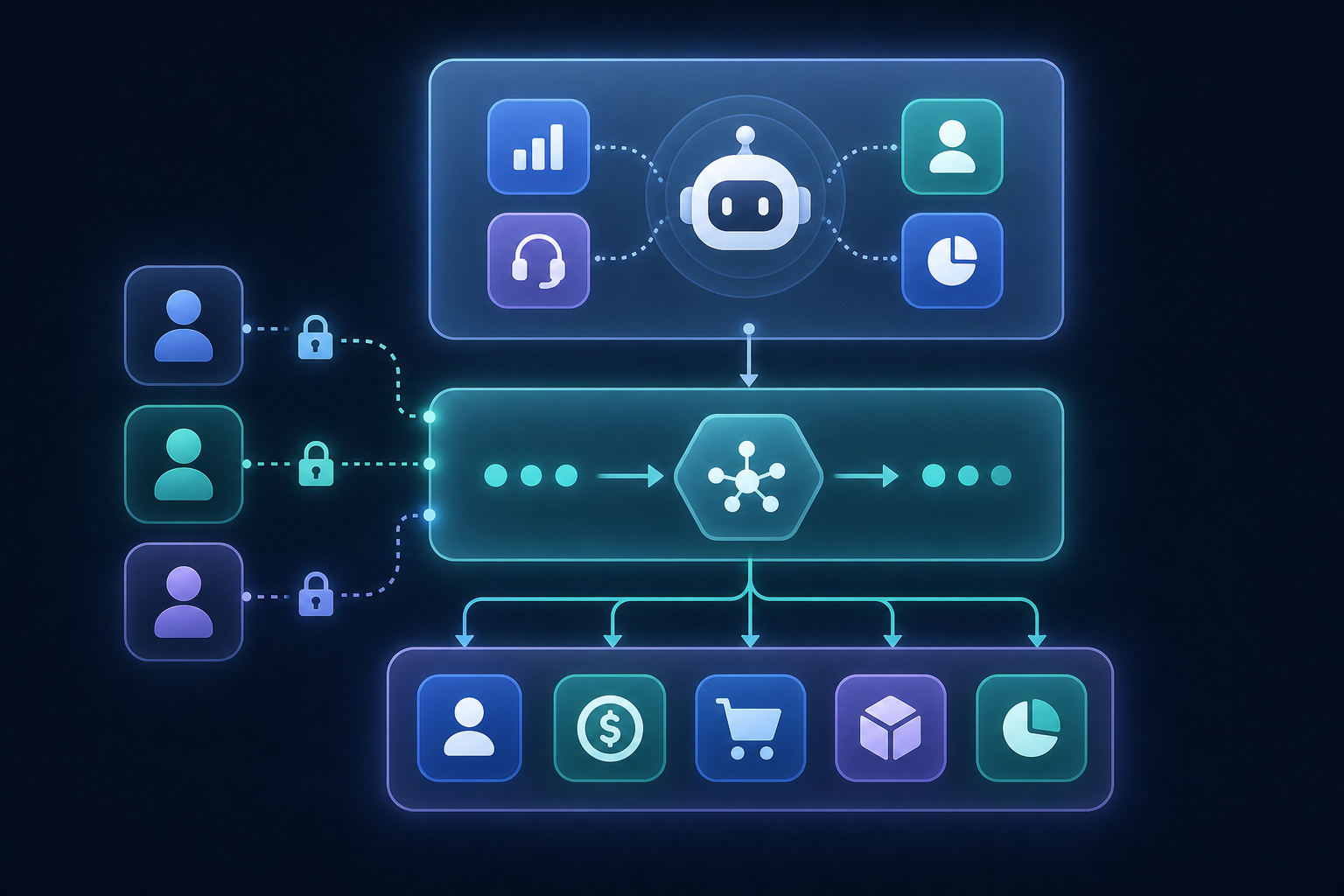
A production MCP deployment has three layers: the MCP host (the AI agent or LLM client), the MCP client (the layer that lists available tools), and the MCP server (the service that actually talks to external systems like Salesforce or QuickBooks). In a multi-tenant B2B SaaS environment, one deployed MCP server must securely broker access for thousands of customers, each with their own OAuth tokens, permission scopes, and connected tools.
The hard part is isolation. Tenant A's Shopify credentials cannot bleed into Tenant B's session, and the LLM itself should never see raw tokens. Every tool invocation needs to resolve against the right customer's linked accounts, not a shared credential pool.
The Security and Auth Complexity Nobody Warns You About
The credential model that works fine in a single-tenant prototype becomes a liability fast. Static API keys stored in environment variables are the most common first mistake: if one key is compromised, the blast radius covers every customer routed through it.
Tenant isolation is the more subtle problem. OAuth tokens need to be scoped per customer, resolved at request time, and never passed to the LLM itself. Prefactor's breakdown of multi-tenant MCP security identifies the same failure modes repeatedly: cross-tenant data leaks, misconfigured access controls, and insecure token storage. Short-lived tokens help, but only if your rotation logic actually works at scale across thousands of active sessions.
The audit trail gap shows up in SOC 2 reviews. Reviewers want to see which agent accessed which customer's data, when, and under what permission scope. Most DIY MCP setups log tool calls but not the tenant context behind them, which is exactly the question auditors ask first.
When to Build Your Own MCP Server vs. When to Delegate
The real answer depends on how many connectors you need, how fast you need them, and how much of your engineering roadmap you want to spend on auth plumbing, a tradeoff our decision framework for build vs. buy walks through in more detail.
Building your own MCP server makes sense in one scenario: you have one or two internal tools, a dedicated infra engineer, and no plans to add connectors for the next year. You write the tool definitions, wire up OAuth for each system, and ship it.
The math changes fast once you add tenants. Multi-tenant OAuth management alone, covering token storage, rotation, per-tenant scoping, and error recovery, is several weeks of engineering before you write a single business-logic tool. Add rate limit handling, schema normalization so your agent doesn't have to know that Salesforce calls it AccountId and QuickBooks calls it Customer, and connector maintenance when upstream APIs change, and you're looking at a small team's full-time work.
| Factor | Build Your Own MCP Server | Use an Embedded iPaaS (e.g. Hotglue) |
|---|---|---|
| Connectors needed | 1 to 2 internal tools | 3+ connectors (QuickBooks, Salesforce, Shopify, etc.) |
| Multi-tenant OAuth | You build token storage, rotation, and per-tenant scoping | Handled by the platform; scoped per tenant via a single API call |
| Time to first agent feature | Several months of auth and infra work before business logic ships | Days: auth and connector maintenance are off your backlog |
| Rate limit handling | You implement per-tenant budgets, backoff, and idempotency | Built into the connector layer; Hotglue monitors upstream API changes |
| SOC 2 / compliance | Your responsibility to design and document the audit trail | SOC 2 Type II certified; process-and-deliver model, no data retained |
| Connector maintenance | Your team owns updates when upstream APIs change | Platform team monitors and migrates connectors proactively |
A few questions worth running through before committing:
- How many connectors do you need in the next 12 months?
- Do you have engineers who want to own connector maintenance long-term?
- Is MCP infrastructure a product differentiator for your customers, or invisible plumbing they'll never see, the same question product teams face when assessing what iPaaS actually is?
- Can your roadmap absorb 2-3 months of auth and infra work before agent features ship?
MCP ecosystem growth has been rapid, with over 10,000 active public MCP servers already documented, but the connectors your B2B customers actually need, QuickBooks, Salesforce, Shopify, Paylocity, are still integration work that has to happen somewhere. The question is whether that work lives on your backlog or someone else's.
Rate Limiting, Idempotency, and the 429 Problem at Scale
At the agent-to-API layer, parallelism is the real culprit. A user clicking through a CRM generates one request at a time, but an agent reasoning through a task might fan out a dozen tool calls across Salesforce, QuickBooks, and Shopify before returning a single response. Multiply that by hundreds of concurrent tenants and you hit 429s fast.
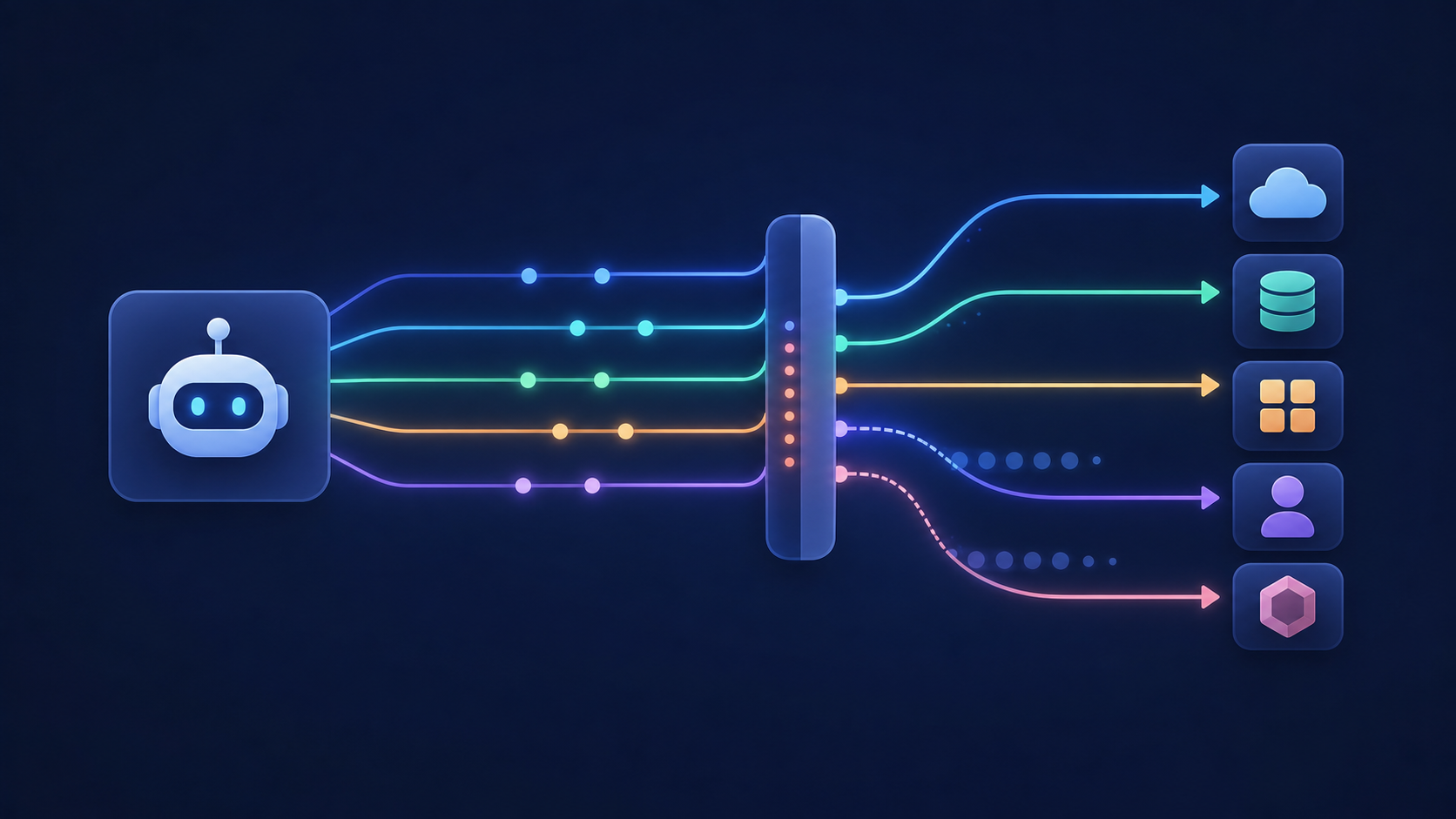
The retry problem compounds things further. Most agent frameworks have built-in retry logic, which sounds helpful until your agent retries a failed write and creates a duplicate invoice because the original request succeeded before the timeout. Idempotency keys exist to prevent this, but only if every connector in your stack implements them correctly.
A few guardrails worth building before you go to production:
- Per-tenant rate limit budgets, not shared pools across your whole customer base, so one busy tenant doesn't starve everyone else
- Idempotency key enforcement at the connector layer, not the agent layer, so the guarantee holds regardless of which framework is calling
- Exponential backoff with jitter, not fixed-interval retries that create synchronized thundering herd patterns under load
- Dead-letter queuing for failed tool calls so nothing silently drops without a trace
The connector maintenance piece is easy to underestimate. When Salesforce changes a rate limit tier or QuickBooks adjusts concurrency caps, someone has to catch that and update the logic. Hotglue's integrations team actively monitors third-party API changes and migrates connectors accordingly, keeping that maintenance burden off your roadmap.
What "Data Security" Actually Means for MCP-Connected Agents
When an AI agent reads a live invoice from a customer's QuickBooks account, that data has to go somewhere before it reaches the LLM. Where it goes, and how long it stays there, is the question procurement teams ask and most vendors answer vaguely.
The cleanest model is process-and-deliver: data is read from the source, passed through to your system, and never persisted by the integration layer. The alternative is store-and-replay, where the vendor caches records to speed up subsequent requests. Store-and-replay is faster, but it creates a new data controller in your compliance chain. Under GDPR, that vendor now holds personal data on your customers' customers, which means data processing agreements, retention schedules, and a new surface area in your next audit.
SOC 2 reviewers care about this distinction too. The question they ask is not whether data is encrypted in transit, but whether it's retained at all, and under whose access controls.
A few questions worth asking any MCP integration vendor before you sign:
- Does the integration layer store customer data, or process and discard it immediately?
- Can the vendor provide a data flow diagram showing where tenant records are held and for how long?
- Is the vendor SOC 2 Type II certified, and does that certification cover the MCP layer in particular?
- Who has internal access to tenant data during a sync?
Hotglue is SOC 2 Type II certified and built on a process-and-deliver model, meaning data is never stored as a long-lived record in the integration layer. It processes and delivers directly to you.
How hotglue Approaches MCP Connectivity for Embedded AI Agents
Hotglue's Composite MCP endpoint (https://mcp.hotglue.com/mcp) is built for the multi-tenant problem. Each tenant gets a scoped MCP token via a single API call, and the endpoint surfaces only the tools from connectors that tenant has already linked. If a customer connected Salesforce and QuickBooks Online but not Shopify, the agent sees exactly two connectors worth of tools, namespaced cleanly so there's no ambiguity about which system a call targets.
Auth flows through the same widget and Magic Link infrastructure your customers already use. No re-OAuth, no separate credential management layer to build. When a tenant authenticates a connector, that connection is immediately available to the MCP layer.
The connector breadth matters too. QuickBooks Online, NetSuite, Salesforce, HubSpot, Shopify, Paylocity, and hundreds more are already in the catalog.
This runs on the same infrastructure processing roughly 10 billion records weekly across 38,000+ active tenants. SOC 2 Type II certification is in place, so the compliance questions your procurement team will ask already have answers.
Final Thoughts on MCP Architecture and AI Agent Data Connectivity
Most of the hard parts of MCP in production aren't about the AI at all. They're about OAuth, rate limits, tenant isolation, and keeping connectors current when upstream APIs change without warning. Your agent features are what move the product forward, and none of that infrastructure is the part your customers care about.
That's exactly why hotglue exists. It handles the multi-tenant OAuth, the connector maintenance, the SOC 2 audit trail, and the MCP layer, so your team ships agent features instead of spending months on plumbing that users will never notice. One API call scopes a tenant's tools. Hundreds of connectors are already in the catalog. The compliance questions your procurement team will ask already have answers. If that sounds like the kind of unfair advantage your roadmap deserves, book a demo and see it in action.
FAQ
What embedded iPaaS platforms support AI agent and MCP authentication workflows?
Hotglue is one of the few embedded iPaaS providers with native MCP authentication support built in; its Composite MCP endpoint (https://mcp.hotglue.com/mcp) handles per-tenant token scoping, so each customer's agent session resolves against their own linked connectors without any shared credential pools. Most embedded integration providers (Prismatic, Paragon, Tray Embedded) handle scheduled sync workflows well but don't yet expose MCP-native auth for AI agent connectivity at the tenant level.
What are MCP servers and why are they becoming important for B2B SaaS integrations?
An MCP server exposes tools to an AI agent, telling it what actions are available across connected systems like Salesforce, QuickBooks Online, or Shopify, so the agent can reason and act without a human writing custom glue code for every interaction. For B2B SaaS products embedding AI agents, MCP is becoming the connective tissue between the LLM layer and live customer data, replacing the static context windows and nightly ETL pipelines that cause agents to silently degrade in production.
Can I give my AI agents live access to customer data from QuickBooks or Salesforce without storing it on my servers?
Yes, using a process-and-deliver integration model where data is read from the source and passed directly to your system without being cached or retained by the integration layer. Hotglue is SOC 2 Type II certified and built on exactly this model, which means you avoid creating a new data controller in your compliance chain and the audit questions around GDPR retention schedules don't apply to the integration layer.
Should I build my own MCP server or use an embedded iPaaS for AI agent data connectivity in a multi-tenant SaaS product?
Building your own MCP server makes sense if you have one or two internal tools and a dedicated infra engineer with no plans to scale connectors. Once you add multi-tenant OAuth management, per-tenant token scoping, rate limit handling across Salesforce, QuickBooks, and Shopify, plus connector maintenance when upstream APIs change, you're looking at several months of engineering work before a single business-logic feature ships.
What is the difference between a unified API and an embedded iPaaS for SaaS integrations?
A unified API locks your customers into a fixed data abstraction: you get one schema across all connectors, but you can't customize mappings or transformations when a customer's data doesn't fit the mold. An embedded iPaaS like Hotglue uses a unified schema model instead, meaning your team controls how data is mapped and converted per customer, which matters when one customer's QuickBooks chart of accounts looks nothing like the next one's.