If you're a CPO or Head of Partnerships at a B2B SaaS company, integrations are probably already on your roadmap — and already causing headaches. Building them in-house feels low-stakes early on and very high-stakes about a year later. A unified API gets you coverage across a category fast, but a shared schema can only stretch so far before a customer's custom NetSuite setup breaks your assumptions. Understanding where unified APIs stop and where embedded iPaaS picks up is what keeps your integrations working when things get complicated.
TLDR:
- Unified APIs give you speed and breadth; embedded iPaaS gives you per-tenant control and write-back depth
- Integration maintenance runs 15-25% of original build cost per year, compounding across every connector you own
- Choose unified API for read-heavy, single-category syncs; choose embedded iPaaS for bidirectional ERP or on-premise systems
- MCP handles AI agent discovery, but your integration layer still manages OAuth, rate limits, and audit logging underneath
- Hotglue offers embedded iPaaS with per-tenant schema customization, including on-premise connectors like QuickBooks Desktop and Sage 300 CRE
What Is a Unified API?
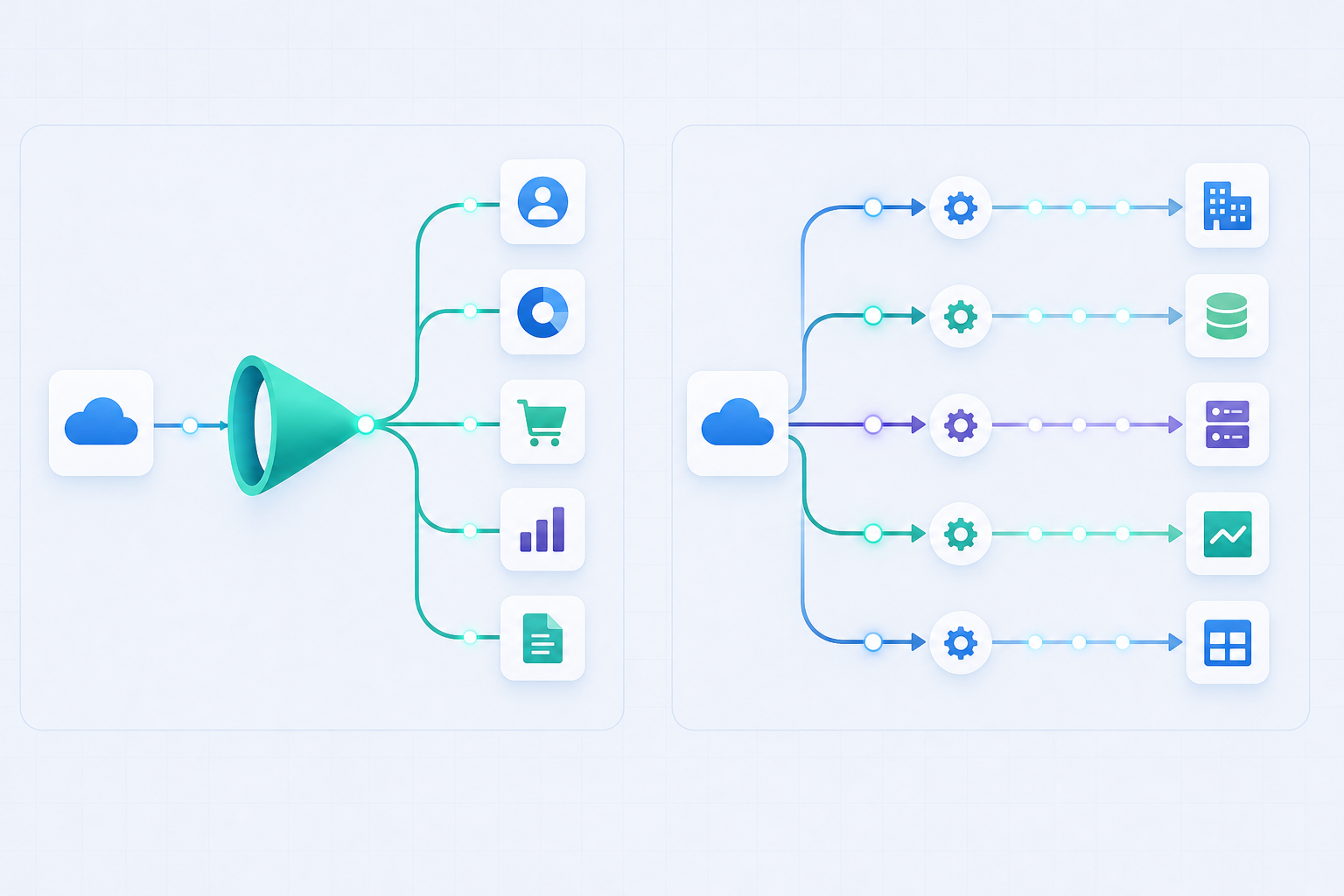
A unified API is a single endpoint that sits in front of multiple SaaS tools in the same category (CRM, accounting, HRIS) and normalizes their data into one shared schema. Instead of building separate connectors for Salesforce, HubSpot, and Pipedrive, you integrate once and get access to all three through a consistent interface.
Your team writes against one data model, and the unified API provider handles the per-connector translation layer underneath. For product teams racing to support a dozen CRM options without tripling their engineering backlog, that trade-off sounds attractive.
The catch, as withampersand.com notes, is that unified APIs are bound by their own abstraction: schema drift across tenants, shallow sync with delayed data freshness, and limited per-tenant customization. The shared schema that makes them fast to adopt is the same thing that makes them hard to extend when a customer's NetSuite setup looks nothing like the normalized model expects.
What Is an Embedded iPaaS?
Embedded iPaaS sits inside your product. End users connect their tools, say QuickBooks or Salesforce, from within your application, and the integration layer handles everything underneath: OAuth authentication, sync scheduling, data transformation, and error handling.
The "embedded" part is what separates it from tools like Zapier or Workato. Those are automation builders your team operates. An embedded iPaaS is something your customers experience, usually without ever knowing it's there. The integration feels native because it is native, white-labeled and displayed inside your product's UI.
Where a unified API gives you a normalized schema and leaves the rest to your engineers, an embedded iPaaS manages the full pipeline. Authentication flows, incremental syncs, field mapping, and job retries are all handled for each tenant independently, with your engineering team configuring the behavior once.
How Unified APIs and Embedded iPaaS Actually Differ
The core difference comes down to who controls the data model, and how much variation you can tolerate across tenants.
| Dimension | Unified API | Embedded iPaaS |
|---|---|---|
| Schema control | Provider-defined, shared | You define it, per connector |
| Per-tenant customization | Limited | Full |
| Sync depth | Often polling-based, shallow | Incremental, stateful, bulk-capable |
| Who configures it | Your engineers, once | Your engineers, once per flow |
| End-user experience | Backend only | Embeddable UI your customers see |
| Speed to first connector | Fast | Slightly longer setup |
| Handles edge cases (e.g. custom fields) | Rarely | Yes |
Speed favors unified APIs early. Control favors embedded iPaaS as your customer base grows and their configurations stop looking anything alike.
The Real Tradeoffs: Breadth vs. Depth
The average enterprise manages over 350 SaaS applications, and each one is configured differently. One customer's NetSuite has 40 custom fields. Another runs QuickBooks Desktop in a multi-user on-premise setup.
Unified APIs win on breadth: one integration, many connectors, fast time to market. That works well when your customers' data looks roughly the same across tools. The problem is that it rarely does, and a normalized schema can only bend so far before it breaks.
Embedded iPaaS trades some of that initial speed for depth: per-tenant field mapping, custom transformations, and stateful incremental syncs that survive API quirks, a tradeoff worth weighing with a proper in-house vs. embedded iPaaS decision framework. Six months in, when your largest customer's ERP looks nothing like your schema expects, depth is what keeps the integration alive.
Where Each Approach Fits Best
The right fit depends on what your integrations actually need to do, and realistically, who on your team is going to own them long-term. For most B2B SaaS companies past the $5M ARR mark, that means your Head of Product or a dedicated integrations engineer, not the person who built the first connector as a side project and has since moved on to other things.
Unified API fits well when you need:
- Read-heavy syncs within one software category, like pulling contacts from any CRM your customers use
- Fraud detection or analytics pipelines where normalized data is the goal
- Employee onboarding dashboards that display HR data without writing back
Embedded iPaaS fits better when you need:
- Bidirectional ERP sync with per-customer field mapping
- On-premise system access like QuickBooks Desktop or Sage 300 CRE
- Complex transformations across multiple source types
- Connectors where two customers using the same tool have completely different schemas underneath
If you're reading normalized data from similar tools, a unified API gets you there faster. If you're writing data back, handling edge cases, or supporting customers whose configurations vary widely, an embedded iPaaS gives you the control to make it work without patching around abstraction limits.
The Hidden Costs of Building Integrations In-House
The first integration always looks cheap. One engineer, a few weeks, done. Then the vendor updates their API, a customer's schema drifts, and the connector breaks at 2am on a Tuesday. (It's always a Tuesday.)
Industry estimates put SaaS maintenance at 15 to 25% of original build cost per year, and integration-heavy products consistently land at the high end of that range. Multiply that across ten connectors with different release cadences, and you have a maintenance tax that compounds quietly until it consumes a meaningful slice of your engineering capacity.
The connectors don't stay built. They stay maintained, indefinitely, by whoever wrote them.
How MCP and AI Agents Are Changing the Integration Equation
MCP gives AI agents a standard way to find and call external tools, but it doesn't replace your integration layer.
As Albato put it: "MCP handles discovery and the tool call. Your iPaaS handles the governed execution underneath it: multi-tenant OAuth, orchestration, rate limits, and audit logging that a raw MCP server does not provide."
MCP and embedded iPaaS are complementary, especially once you factor in MCP auth for AI agents. MCP is the interface AI agents use to find tools; your integration layer is what makes those tool calls safe, authenticated, and auditable across every tenant. Without the latter, you have discovery with no guardrails.
A Four-Question Decision Framework
Before picking a tool, run through these four questions. Your answers will point you toward a unified API, an embedded iPaaS, or a hybrid of both.

1. How much per-tenant customization do your customers require?
If every customer's data looks roughly the same, a unified API's shared schema holds up fine. If your customers run different ERP configurations, custom fields, or non-standard workflows, you'll spend more time working around the abstraction than benefiting from it. High variation means you need per-tenant control, which is embedded iPaaS territory.
2. Are you integrating within one software category or across many?
Unified APIs are built around categories: CRM, HRIS, accounting. One category, one schema, though this is also where where unified APIs fall short for CRM. If you need CRM plus accounting plus e-commerce sync within the same product, you're stitching multiple unified APIs together, or you're better served by an embedded iPaaS that handles cross-category pipelines natively.
3. Do you need bidirectional, stateful sync or primarily read-only access?
Reading normalized data is where unified APIs shine. Writing data back, handling incremental state, or syncing across systems with different schemas is where they struggle. If your integration writes journal entries to QuickBooks or syncs purchase orders back to an ERP, embedded iPaaS is the safer choice, especially given why ERP integrations are harder than expected.
4. What is your engineering team's actual capacity for ongoing maintenance?
Whichever path you choose, connectors require upkeep. An embedded iPaaS offloads that maintenance burden. If your team is already stretched across product work, handing connector maintenance to a vendor is often the more accurate accounting of your real capacity.
When a Hybrid Approach Makes Sense
Some teams genuinely need both, and that's a legitimate architecture. A unified API can cover read-heavy, category-specific connectors quickly, say pulling contacts from any CRM a customer uses, while an embedded iPaaS handles connectors where customization and write-back matter: ERP sync, on-premise accounting, or integrations where two customers using the same tool have completely different data underneath.
One real caveat: running both adds vendor relationships, authentication flows, and debugging surfaces. A hybrid works well when the boundary between the two is deliberate, not a symptom of indecision. If you find yourself using a unified API for convenience and an embedded iPaaS to fix what the unified API can't handle, that's a signal to consolidate sooner.
How hotglue Approaches the Embedded iPaaS Problem
Hotglue is the embedded iPaaS built specifically for B2B SaaS teams that need real integration depth — not a lowest-common-denominator abstraction. Open-source connectors (Singer and Airbyte compatible), tenant-based pricing, and a unified schema you can customize per customer make it the most flexible option on the market for teams who've outgrown what a unified API can do.
The numbers back it up: 70+ B2B SaaS customers, 38,000+ active tenants, roughly 10 billion records processed weekly. Customers like Chargebee have cited a 90% reduction in integration implementation time after switching from in-house builds. That's not a rounding error — that's your engineering team getting their roadmap back.
Where hotglue pulls further ahead is in connector categories that unified APIs avoid entirely: QuickBooks Desktop via Windows agent, Sage 300 CRE installed on-premise, and Sage 200 via cloud proxy. These aren't edge cases for our customers. They're the integrations that close deals — and the ones your competitors probably can't support.
For teams building AI-native workflows, our Composite MCP endpoint gives AI agents authenticated, tenant-scoped access to every connected system through a single endpoint, without re-doing OAuth for each one.
Final Thoughts on Picking the Right Integration Approach for Your Product
The four questions in this post are worth actually working through before you commit to a direction. Unified APIs and embedded iPaaS each do specific things well, and the gap between them widens fast once your customers start customizing. Getting the architecture right early saves a lot of quiet maintenance debt later. If embedded iPaaS sounds like the right fit, grab some time with the hotglue team to walk through what that looks like for your product.
FAQ
What is the difference between a unified API and an embedded iPaaS for SaaS integrations?
A unified API gives you one normalized schema across similar tools (like CRM or HRIS), so your engineers write against a single model and the provider handles per-connector translation. An embedded iPaaS sits inside your product and manages the full pipeline per tenant, covering authentication, sync scheduling, field mapping, and error handling, with the flexibility to handle custom fields, write-back, and configurations that vary widely across your customer base. The practical gap shows up at scale: unified APIs get you to your first connector faster, while an embedded iPaaS keeps integrations alive when your largest customer's NetSuite setup looks nothing like the normalized model expects.
Unified API vs embedded iPaaS for SaaS integrations: which should I pick if my customers use different ERP configurations?
If your customers have meaningfully different ERP setups, such as custom fields, non-standard workflows, or on-premise systems like QuickBooks Desktop or Sage 300 CRE, an embedded iPaaS is the right choice. Unified APIs are built around shared schemas that work well when data looks roughly the same across tenants, but break down when configurations diverge, and writing data back to an ERP is where that abstraction hits its limit fastest.
What embedded iPaaS platforms support AI agent and MCP authentication workflows?
MCP handles tool discovery and the call itself, but the governed execution layer, including multi-tenant OAuth, rate limiting, and audit logging, still lives in your integration platform. Hotglue's Composite MCP endpoint gives AI agents authenticated, tenant-scoped access to every connected system through a single endpoint, so you're not re-doing OAuth per tool or per tenant.
How do I decide when a hybrid unified API and embedded iPaaS architecture actually makes sense?
A hybrid is worth considering when you have a clear category of read-heavy, low-variation connectors (like pulling contacts from any CRM) alongside a separate set of connectors that require write-back, custom field mapping, or on-premise access. The warning sign is using a unified API for convenience and an embedded iPaaS to patch what it can't handle. That's a signal to consolidate, not a sign the hybrid is working.
How does an embedded iPaaS remain worth using for a SaaS team that has already built most of its integrations in-house?
The build cost is rarely the real problem. It's the maintenance. API endpoint changes, schema drift, and connector rebuilds after vendor updates consume engineering time indefinitely, and that tax compounds across every connector your team owns. An embedded iPaaS like Hotglue takes that ongoing maintenance burden off your engineers' plates, so the team that built your first ten connectors in-house can stop being on-call for them and get back to product work.