If you're comparing Portable.io or Fivetran because your customers want native integrations, you're looking at the right category of tool but the wrong shelf. ELT tools pull data into a warehouse your internal team controls. That's genuinely useful, but it has nothing to do with letting a customer connect their Salesforce account from inside your app. Here's where the line actually falls between these two very different problems.
TLDR:
- ELT tools like Fivetran and Portable.io move data into your warehouse for internal analysts, not your customers
- If customers are asking for integrations during sales calls, an ELT tool won't solve that problem
- Embedded iPaaS handles per-tenant OAuth, white-labeled UI, and multi-tenant scoping that ELT tools have no architecture for
- Portable.io bills per pipeline flow ($1,800-$2,800/month); embedded iPaaS tools bill per connected customer tenant
- Hotglue is an embedded iPaaS priced on active tenants, built for customer-facing integrations inside B2B SaaS products
What Is an ELT Tool (And What Problem Does It Actually Solve)
ELT stands for Extract, Load, Transform. Unlike older ETL pipelines that cleaned data before moving it, ELT tools pull raw data from source systems and drop it directly into a cloud data warehouse first. The transformation happens after, inside the warehouse, using tools like dbt.
The destination is always the warehouse: Snowflake, BigQuery, Redshift, PostgreSQL. Once data lands there, analysts and BI tools can query it, model it, and build dashboards on top of it.
Portable.io describes its core use cases as analytics and automation for data engineers extracting from SaaS apps and loading into a warehouse. Fivetran operates on the same model, with a catalog of connectors that replicate data from production sources into storage destinations. Both solve a data centralization problem for internal teams.
The key word is internal. ELT tools are built for data engineers who need a single source of truth inside their own organization. Your customers never touch these pipelines. The output is a warehouse table, not a product feature.
What Is an Embedded iPaaS
An embedded iPaaS (Integration Platform as a Service) puts the integration layer inside your product, visible to your end customers, and operated on their behalf.
With an ELT tool, your data team configures the pipelines. With an embedded iPaaS, your customer connects their own Salesforce, QuickBooks, or Shopify account directly inside your app. They authenticate, they see sync status, they manage their data. The integration becomes a product feature, not a backend process.
This also separates embedded iPaaS from general-purpose automation tools like Zapier or Workato, which let users build workflows between apps they personally own, and it's a different decision entirely from choosing between a unified API vs embedded iPaaS approach. Embedded iPaaS is controlled by the SaaS vendor, configured once per connector, and deployed across every customer tenant who needs it. One connector definition, thousands of customer connections. The destination is your product's database or API, not a warehouse.
The Core Architectural Difference: Warehouse vs. Product
ELT tools move data in one direction: toward a warehouse your internal team controls. Every pipeline Fivetran or Portable.io runs terminates at a table in Snowflake or BigQuery. The consumer of that data is an analyst or a BI dashboard, not your customer.
Embedded iPaaS runs in the opposite direction. Data flows from your customer's source systems into your product's infrastructure, scoped to that customer's account, on their behalf. The consumer is your end user, inside your app.
The tenant boundary is what makes this architecturally distinct. An ELT tool has no concept of tenants. It serves one organization's data team. An embedded iPaaS is built around thousands of isolated customer connections, each authenticated separately, each producing data that belongs to a different account in your system, which is why teams weighing in-house vs. embedded integration need a clear framework before committing engineering resources.
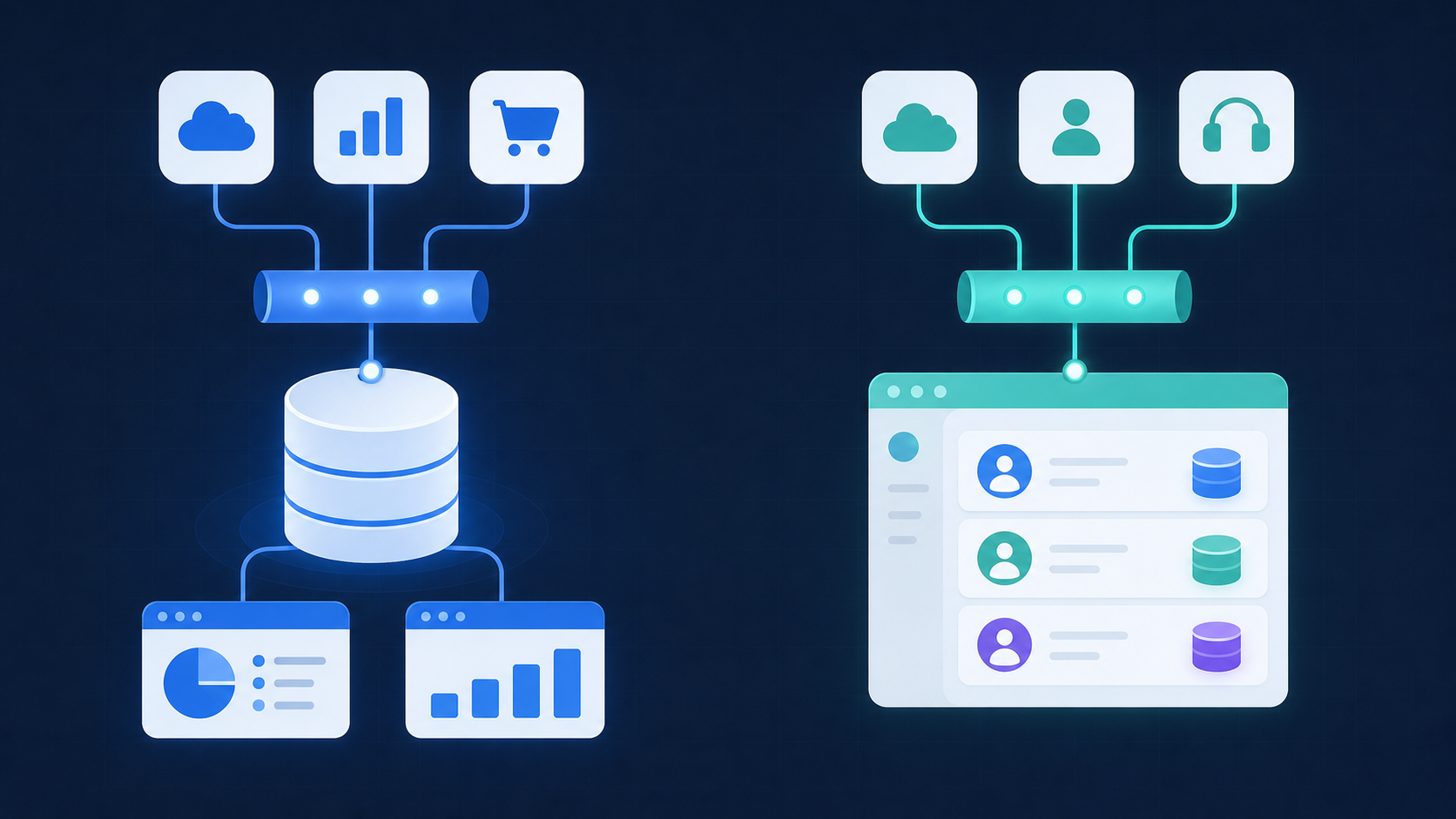
| Dimension | ELT Tool (Fivetran, Portable.io) | Embedded iPaaS (hotglue) |
|---|---|---|
| Data destination | Cloud warehouse | Your product's database or API |
| Who configures it | Your data engineer | Your engineering team, once |
| Who uses the output | Internal analysts, BI tools | Your end customers |
| Multi-tenant by design | No | Yes |
| Customer-facing UI | No | Yes |
| Connector code | Closed source (Fivetran) | Open source, inspectable and customizable |
| Transformation | SQL via dbt (Fivetran) | Python-powered transformation layer |
Who Actually Uses ELT Tools Like Portable.io and Fivetran
The buyer for Portable.io or Fivetran is almost always a data engineer or analytics engineer inside one company, solving that company's own reporting problems. Portable.io's pricing is structured around active data flows into warehouse and database destinations, with tiers built for teams syncing their own company's data. The user is internal. The output is a dashboard. (A very nice dashboard, admittedly — just not one your customers will ever see.)
Fivetran's recently announced merger with dbt Labs consolidates ingestion and transformation under one roof, deepening its focus on warehouse-native analytics infrastructure for data teams.
Neither product is designed for a B2B SaaS company that wants its customers to connect their own CRM or accounting system from inside the product. That's not a criticism. It's just not the problem either tool was built to solve.
Who Actually Uses Embedded iPaaS Tools
The buyer here is a CPO, Head of Partnerships, or VP of Engineering at a B2B SaaS company whose customers keep asking for integrations. Not one customer. Many customers, across every sales call and every renewal conversation. At that point integrations stop being a nice-to-have and become a recurring sales blocker.
The request usually sounds like: "Can you connect to QuickBooks?" or "We need Salesforce sync before we can expand." A SaaS company in the accounting space, for example, can hear that same ask from prospect after prospect before they commit. The SaaS vendor needs that connection to live inside their product, scoped to each customer's account, white-labeled, and working reliably across thousands of tenants simultaneously.
They're building a product feature, not a reporting pipeline.
When ELT Solves the Right Problem
If your problem is getting your own company's data into one place so analysts can query it, an ELT tool is the right answer.
Reach for Fivetran or Portable.io when:
- You're building internal BI dashboards in Looker, Tableau, or Metabase and need reliable, scheduled data syncs your analysts can trust.
- Your marketing team needs ad spend, CRM, and revenue data in one warehouse for attribution reporting.
- Your data team is centralizing logs, product events, or transactional records into Snowflake or BigQuery.
- You're feeding a data lake that downstream ML pipelines or finance models consume.
The person configuring these pipelines is on your team. The output never surfaces to a customer. Success looks like a clean dbt model and a dashboard that loads fast on Monday morning.
This is a real, valuable problem. If your Head of Data is drowning in one-off connector requests for internal reporting, an ELT tool solves that cleanly and at scale.
When Embedded iPaaS Solves the Right Problem
Reach for an embedded iPaaS when your customers are the ones who need the integration, not your internal team.
The triggering signal is usually a pattern in sales calls or renewal conversations: "We'll sign if you connect to NetSuite," or "Our team already lives in Salesforce, can your product pull data from there?" The request is coming from outside your organization. An ELT tool can't help with that.
Use an embedded iPaaS when:
- Customers need to connect their own CRM, accounting system, or e-commerce stack from inside your product
- You need per-tenant authentication, so each customer's credentials stay scoped to their account
- The integration UI needs to look like part of your product, not a third-party tool bolted on
- You're deploying the same connector across hundreds or thousands of customer accounts simultaneously
- Your CS team is manually handling data exports because there's no native sync
The person feeling this pain is usually in customer success or partnerships, not the data team. The fix isn't a warehouse pipeline. It's a product feature.
The Pricing and Billing Model Divergence
ELT tools and embedded iPaaS tools are built on completely different economic assumptions, and that shows up immediately in how they bill you.
Portable.io's pricing runs $1,800/month for 6 flows on their Standard tier and $2,800/month for 15 flows on Pro. The price has nothing to do with how many customers you serve. It scales with pipeline count.
Fivetran uses a monthly active row model, where cost scales with data volume, which can get unpredictable fast as your syncs grow.
Embedded iPaaS tools price on active tenants instead, where each connected customer account is the billing unit. Hotglue works this way because the integration scales with your customer base, not your internal data volume. That model is explained in more depth in our breakdown of per-tenant integration pricing.
The billing model tells you something about who the integration actually serves. Per-flow pricing assumes one organization configuring pipelines for itself. Per-tenant pricing assumes a SaaS vendor deploying integrations across a growing customer base, and the pricing model you pick can directly affect customer retention.
The White-Label and Tenant Authentication Gap
ELT tools authenticate once, for your organization. There is no mechanism to issue separate OAuth flows per customer, scope credentials to individual accounts, or present a branded connection UI inside your product. Fivetran connects your company's Salesforce. It has no architecture for connecting 800 different customers' Salesforce accounts, each isolated, each white-labeled under your brand. Fivetran's white-label route is a separate, higher-priced OEM product ("Powered by Fivetran"), while Hotglue supports white-label deployments natively.

Embedded iPaaS tools are built around exactly this requirement. Per-tenant auth, white-labeled widgets, and in-product embedding are not add-ons; they are the core design, a distinction worth understanding when comparing different iPaaS integration platforms. When a customer connects their QuickBooks inside your app, that OAuth token belongs to their account only. Another tenant never sees it.
This gap matters even when the connector catalogs overlap. Fivetran may support the same source as hotglue, but supporting a source for your internal warehouse and supporting it for thousands of customer-scoped OAuth flows are entirely different engineering problems.
Can You Use Both an ELT Tool and an Embedded iPaaS Together
Yes, and for some companies this is exactly the right architecture.
Your data team might run Fivetran pipelines into Snowflake for internal reporting while your product team deploys hotglue to serve customer-facing integrations. These tools solve problems for different audiences inside the same company.
Where this breaks down is when teams try to use an ELT tool as a substitute for embedded integration, often because of lingering stigma around embedded iPaaS from earlier, clunkier generations of the technology. Engineering routes customer data through an internal warehouse pipeline instead of building a proper per-tenant sync. It works until a customer asks why their competitor's data is visible in their account, or why credentials aren't isolated, or why the connection UI looks nothing like your product.
ELT tools have no tenant model. Bolting multi-tenant requirements onto a single-org pipeline creates security and scoping problems that compound as your customer base grows.
If you have both internal analytics needs and customer-facing integration requirements, use both tools for what they were designed for.
Where Hotglue Fits in This Picture
Hotglue is an embedded ETL and iPaaS platform built for B2B SaaS teams that need customer-facing integrations inside their product. It's designed for the per-tenant scale and complexity that ELT tools were never meant to handle. Priced on active tenants instead of internal data flows, your costs grow with your customer base, not your data team's appetite for dashboards.
Where Fivetran and Portable.io charge based on internal data volume and pipeline count, Hotglue's cost scales with your connected customer base. Growth is reflected in pricing, not penalized through data volume or connector count.
The scale backs this up: Hotglue processes roughly 10 billion records weekly across 38,000+ active tenants and 70+ B2B SaaS customers, a footprint documented in hotglue's 10 billion records scale breakdown. Every one is a customer-facing integration embedded inside a product, not an internal analytics pipeline.
Connector depth matters too. 650+ open-source connectors, Python-powered data processing, SOC 2 Type II compliance, and support for on-premise systems like QuickBooks Desktop and Sage 300 CRE cover integration categories that ELT tools typically avoid entirely, including the accounting and fintech connectors compared in our fintech integration guide. If your customers run legacy accounting software, Fivetran won't help you there.
If the problem you're solving belongs to your customers and not your data team, that's the line where ELT tools stop and embedded iPaaS begins. Hotglue sits on the customer-facing side of that line: open-source connectors you can inspect and modify, Python-powered transformations, per-tenant pricing, a white-labeled UI, SOC 2 Type II compliance, and the depth to handle on-premise accounting software like QuickBooks Desktop that a warehouse pipeline would simply ignore. It's built for the scale and reliability a B2B SaaS product demands. From there, it helps to know how to choose an embedded iPaaS for your team.
Final thoughts on Picking the Right Integration Approach for Your Product
Your data team and your customers have different integration needs, and the tools that serve them are built on completely different assumptions. ELT tools move your company's data into a warehouse so analysts can query it. Embedded iPaaS moves your customers' data into your product so they can use it. Knowing which problem you're solving saves a lot of expensive course-correcting later. Book time with the hotglue team to walk through what a customer-facing integration setup looks like for your specific use case.
FAQ
What's the difference between Fivetran vs. an embedded iPaaS like Hotglue? Aren't they both moving data between systems?
They move data for completely different audiences. Fivetran moves your company's data into a warehouse your internal analysts query. Hotglue moves your customers' data into your product, scoped to each customer's account. The tenant boundary is the key distinction: Fivetran has no concept of per-customer isolation, while Hotglue is built around thousands of separate authenticated connections running simultaneously inside your product.
Can I use Portable.io or Fivetran to give my SaaS customers a native integration experience inside my product?
No. ELT tools like Portable.io and Fivetran authenticate once for your organization and terminate at a warehouse destination, with no mechanism for per-tenant OAuth flows, white-labeled connection UIs, or customer-scoped credentials. A customer connecting their QuickBooks or Salesforce account from inside your app requires an embedded iPaaS architecture, not a warehouse pipeline.
How does Hotglue's per-tenant pricing differ structurally from Fivetran's monthly active row model and Portable.io's per-flow pricing?
Hotglue bills a base platform fee plus a per-active-tenant fee, counting only tenants that sync within a 30-day rolling window, so your costs scale with your customer base instead of data volume or pipeline count. Fivetran's row-based model can spike unpredictably as sync volume grows. Portable.io's per-flow pricing reflects a single organization managing its own pipelines. The billing unit tells you who the integration actually serves.
Which embedded integration platforms have open-source connectors I can inspect and customize?
Hotglue's full connector library is open-source, giving you direct visibility into the code behind every sync, including connectors for QuickBooks Online, Salesforce, Shopify, NetSuite, and 650+ others. Many embedded iPaaS providers treat connectors as black boxes, and Fivetran's are closed-source. With Hotglue, your engineering team can inspect, fork, or extend any connector, and build custom ones using a no-code builder or Python SDK.
When does it make sense to run both Fivetran and an embedded iPaaS in the same company?
When your internal data team and your product team have separate, legitimate needs. Your data team might run Fivetran pipelines into Snowflake for BI dashboards and attribution reporting, while your product team deploys Hotglue to serve customer-facing integrations. Where this breaks down is when engineering tries to route customer data through an internal warehouse pipeline as a substitute for a proper per-tenant sync. ELT tools have no tenant model, and bolting multi-tenant requirements onto a single-org pipeline creates credential scoping and security problems that compound as your customer base grows.