You're deep in a deal, the prospect loves the product, and then someone asks if it connects to NetSuite. That one question can quietly kill the whole thing. The difference between losing that deal and closing it usually comes down to how fast you can give a real, confident answer.
TLDR:
- 22% of closed-lost deals collapse during solution design, and missing integrations are a top reason why
- Buyers filter on integration compatibility before your demo starts, so a missing connector fails a pre-set requirement
- Tagging closed-lost reasons with specificity (missing vs. incomplete vs. unreliable) gives product teams actionable revenue signals
- Embedded integration tools compress connector delivery from quarters to weeks by handling auth and sync logic upfront
- Hotglue delivers working connectors in one to two weeks from sandbox access, fitting inside a deal's decision window
Integration Gaps as a Sales Blocker
The deal is going well. The champion is excited, the pricing call is done, and then someone from IT asks a single question: "Does this connect with our NetSuite?"
Silence. A check with the product team confirms it's not on the roadmap for another two quarters. The prospect goes quiet. A few follow-up emails go unanswered. Eventually, the opportunity moves to closed-lost with a one-line note: "missing integration."
This happens constantly in B2B SaaS sales, and it rarely gets treated with the urgency it deserves. In fact, 22% of closed-lost B2B deals collapse during solution design (the stage where integration fit gets tested), and missing connectors are a leading reason why. Integration gaps get logged as a product problem, when they're actually a revenue problem sitting right in the middle of your pipeline.
Why Buyers Make Integration a Purchasing Requirement
Buyers don't show up to demos with an open mind about their tech stack. They show up with a list. Their team already runs on specific tools, and those tools are deeply wired into how work actually gets done. Swapping any one piece out carries real switching costs, retraining time, and broken workflows. So when a new vendor can't plug into what's already there, it stops feeling like a minor inconvenience and starts feeling like a risk.
The buying process has also gotten more deliberate. By the time they're in your demo, integration compatibility is often already on the checklist, which is why having an ERP integration product guide ready matters. A missing connection fails a filter the buyer set before the conversation started.
How a Missing Integration Kills the Deal
There are really only three ways this plays out, and none of them are good.
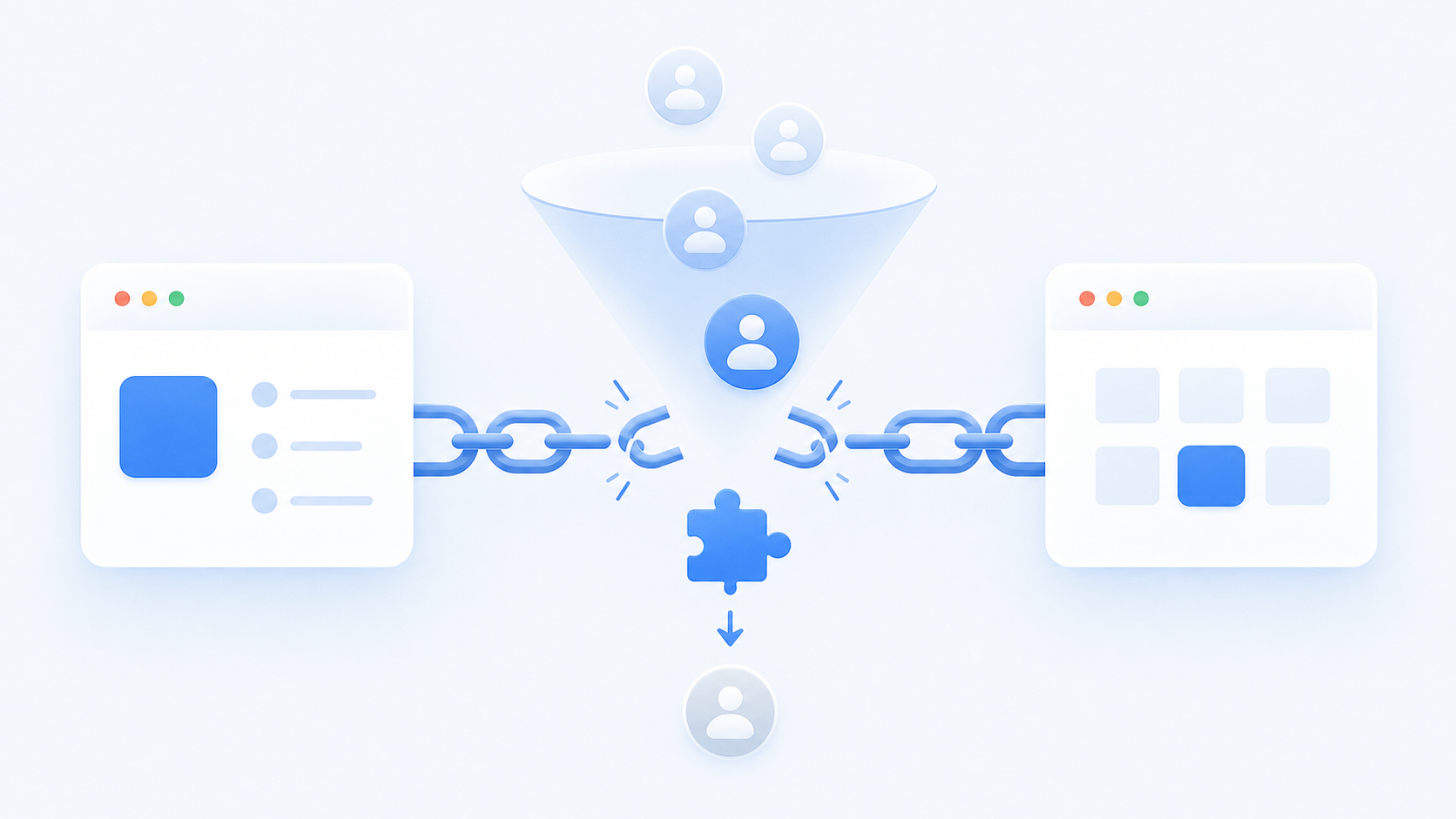
The first is an outright "no": the integration doesn't exist, and the product team can't commit to building it. The prospect moves on. The second is a vague "it's on the roadmap" with no shipping date attached. Prospects hear this as a polite no, and they're usually right to. The third is the quietest killer: the team commits, the prospect waits, and delivery slips past their internal decision deadline. By then, they've signed with someone else.
Sales teams often log these as lost to price or a competitor. 22% of closed-lost opportunities collapse during solution design, when fit can't be confirmed. A missing integration is a fit problem dressed up as a timing problem, and misreading it means the root cause never gets fixed.
The Hidden Cost of "We'll Build It Ourselves"
When a prospect asks for a NetSuite connector and engineering says "we can build that," the conversation usually ends there. What doesn't get said is how long it actually takes, or what gets deprioritized to make room.
A new connector isn't a one-time cost. Third-party APIs change endpoints, deprecate fields, and push breaking updates with little warning. Each connector your team owns becomes a maintenance obligation that compounds quietly over time. Even a single customer's unusual configuration or schema variation can force a connector rebuild.
The engineering hours that go into connector maintenance, part of the real cost of maintaining integrations, are hours not spent on the features that actually set your product apart. That tradeoff rarely shows up on a roadmap, but it shows up in velocity.
How Sales and Product Teams Usually Handle Integration Objections (and Why It Breaks Down)
The typical sequence goes like this: sales flags the integration request, product logs it as a ticket, engineering estimates a quarter, and sales relays something vague back to the prospect. Everyone acted in good faith. The deal still dies. (Nobody's the villain here, just a very broken telephone. And nobody wins a blame game that ends in a closed-lost.)
Ownership of the integration problem typically falls on the CPO or Head of Partnerships: they sit at the intersection of what the product can do and what deals actually need. The breakdown happens at the handoff. Product teams rank roadmap items across a much wider surface than any single deal. A requested NetSuite connector competes with feature work, bug fixes, and the three other integration requests that came in the same week. Without a clear revenue signal attached to the ticket, it drifts.
Sales, meanwhile, is incentivized to keep deals warm, even as engineers dread in-house integrations waiting in the queue. That pressure pushes reps toward soft commitments they can't back up. "We're working on it" buys a few weeks, not a signed contract. When the shipping date slips, there's no recovery.
What "Unblocking a Deal" Actually Requires
Saying "we can build that" is not enough. What actually unblocks a deal is a credible answer to five specific questions a prospect's team will eventually ask.
- Is the connector already available, or does it need to be built from scratch?
- How long from API access to a live, production-ready sync?
- Can the data be mapped to match your system's schema, or does it land raw?
- Who handles authentication edge cases and OAuth maintenance over time?
- What happens when the third-party API changes its endpoints next quarter?
If you can answer all five confidently and quickly, the deal stays alive. If any answer is "we'll figure it out," the prospect is already mentally shopping elsewhere.
Deciding Which Missing Integrations to Build First
Not all integration requests deserve equal urgency. A one-off ask from a single prospect is a data point. The same connector requested across five deals in a quarter is a market signal.
A simple triage framework helps cut through the noise:
- Frequency: how many open deals or churned accounts cited this integration?
- Deal size: what is the average contract value attached to requests for this connector?
- Ecosystem centrality: how deeply embedded is this tool in your target segment's stack? A NetSuite integration request from a mid-market finance team is structural, not incidental.
- Segment unlock: does building this connector open an entire vertical, or just one account?
The problem is that most teams don't track this systematically. Integration requests live in Slack threads, CRM notes, and CS call summaries, scattered across tools and never aggregated. Without a central view, product teams are guessing at priority instead of responding to revenue data.
Closing the Loop Between Lost Deals and Product Roadmap
Lost deals tell you something if you record them correctly. The gap between "missing integration" and "wrong integration" matters: a missing connector means your catalog needs to grow, while an existing connector that syncs the wrong fields or runs too slowly means something you already own is failing in production. Conflating these in your CRM means product fixes the wrong thing.
Start with tagging discipline. Closed-lost reasons need enough specificity to be actionable:
- Missing integration: the connector does not exist in your catalog at all
- Incomplete integration: the connector exists but covers the wrong data or fields
- Integration timeline: the connector was planned but not shipped before the deal closed
- Integration reliability: the connector exists but the prospect lost confidence in its stability
Once that signal is clean, route it to product on a cadence, not as individual Slack pings. That matters especially because ERP integrations are harder than they look once they get picked up. A monthly summary showing deal value lost per tag, by connector requested, gives product teams something they can rank against existing roadmap items. Revenue attached to a ticket moves faster than a feature request without one.
In-House Build vs. Embedded iPaaS: A Side-by-Side Comparison
| Factor | Building In-House | Embedded iPaaS (e.g., Hotglue) |
|---|---|---|
| Time to first working connector | Months (even with an experienced engineer) | 1 to 2 weeks from sandbox access |
| Auth & OAuth handling | Engineered from scratch per connector | Pre-built; never touched by your team |
| API change maintenance | Ongoing obligation; breaking updates cause outages | Handled at infrastructure level by the vendor |
| Rate limiting & sync logic | Custom-built each time | Pre-built; configuration only |
| Real engineering cost | High; compounds per connector over time | Scoped to field mapping & transformation |
| Roadmap impact | Pulls engineers off product-defining work | Frees roadmap for core product features |
| Connector catalog | Each connector built and owned by your team | 650+ open-source connectors, plus a no-code builder and Python SDK for custom ones |
How Embedded Integration Tools Change the Timeline
Building a connector from scratch means starting at zero: scoping the API, handling OAuth edge cases, writing transformation logic, and standing up monitoring before any real data moves. That path reliably takes months, even with an experienced engineer on it.
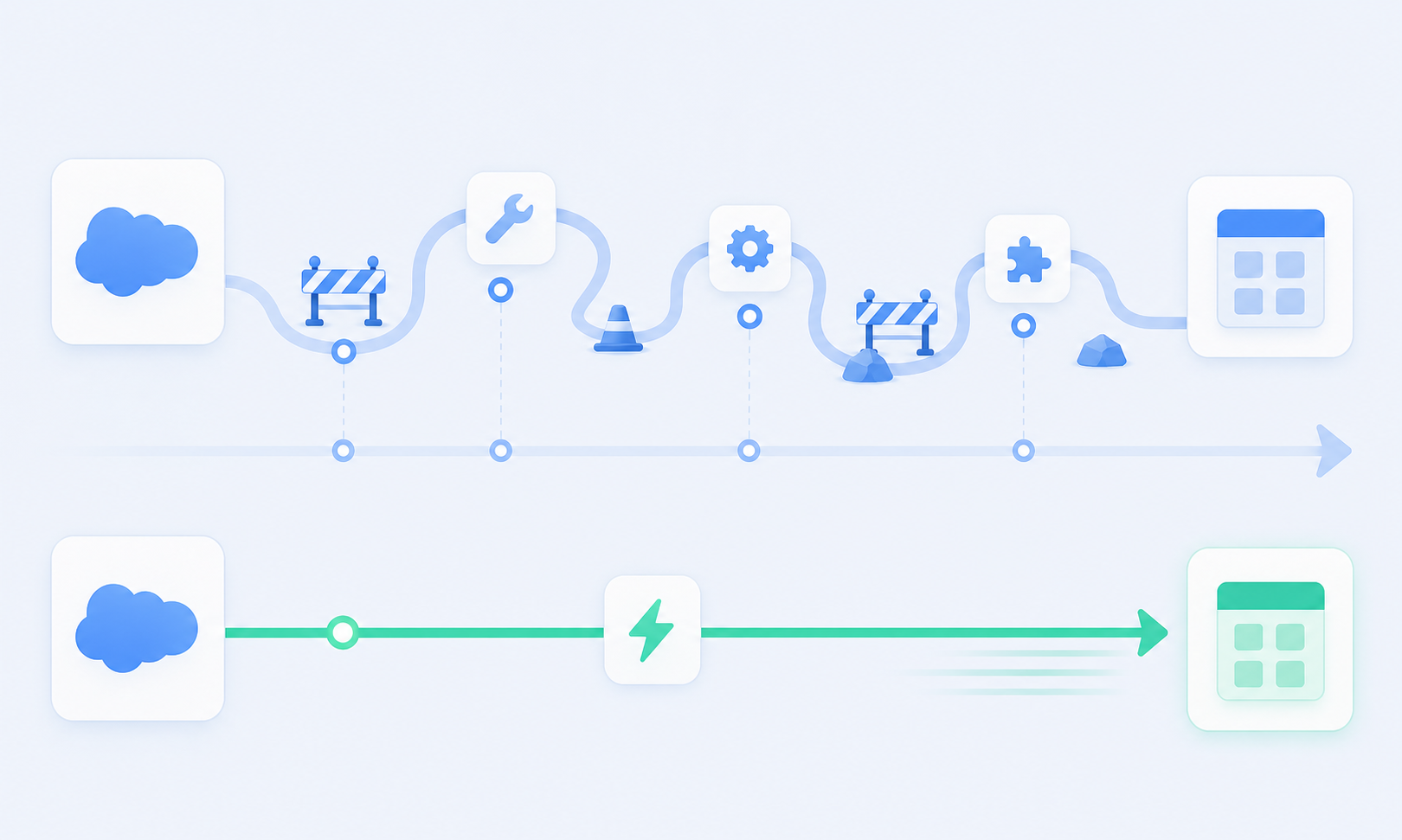
Choosing between building in-house and adopting embedded iPaaS matters here: embedded integration tools compress the timeline because the foundational work is already done. Authentication flows, rate limit handling, and incremental sync logic are pre-built. What's left is configuration and field mapping, which is a materially smaller surface area than writing a connector from nothing.
Three things change when you use an embedded approach:
- Connector reuse: if a Salesforce or QuickBooks connector already exists in the catalog, your team starts from a working baseline instead of a blank file. The customization layer is thin compared to the underlying connector work.
- Auth management: OAuth token refresh, credential storage, and third-party app approval are handled at the infrastructure level. Your engineering team never touches that code.
- Proof-of-concept vs. production gap: a POC can run in days; getting to production typically adds testing, error handling, and schema mapping. With embedded tooling, that gap is measurable in weeks instead of the quarters it takes when building from scratch, and connector maintenance after API changes is handled without surprise outages.
The real caveat is that "faster" still requires real engineering time for data mapping and transformation. No embedded tool eliminates that work entirely. What changes is where your team's time actually goes.
How hotglue Helps B2B SaaS Teams Stop Losing Deals to Missing Integrations
Hotglue was built for exactly this scenario. A prospect asks for a NetSuite or Salesforce connector, and instead of routing that request into a multi-quarter engineering queue, your team can have a working connector in one to two weeks from sandbox access. That timeline fits inside a deal's decision window.
The infrastructure concerns that typically slow connector projects down are handled at the infrastructure level. Hotglue is SOC 2 Type II and GDPR compliant by design, never stores customer data, and follows a SaaS integration pricing model based on active tenants instead of data volume, so costs stay predictable as your integration catalog grows. With 70+ B2B SaaS customers, 38,000+ active tenants, and roughly 10 billion records processed weekly, the reliability bar is already proven at scale.
Hotglue's library includes 650+ open-source connectors, so many requests start from a working baseline. Its integrations team also monitors third-party API changes and migrates connectors to new endpoints, which helps stop losing renewals to integration backlogs. That kind of compression turns "it's on the roadmap" into an answer a prospect can actually wait for.
Internally, Hotglue reports a close rate of around 90% after a completed demo. When you can show a working integration instead of promising one, the objection disappears, and you free your roadmap from integration backlogs for good.
Final Thoughts on Keeping Integration Gaps From Blocking Your Deals
Your sales team cannot close deals on promises alone, and your engineering team cannot absorb every connector request without a cost somewhere else. Getting specific about what you are losing, why, and which connectors would have saved those deals gives product the signal it needs to act. As a CPO or Head of Partnerships, this is your lever, and hotglue is purpose-built to pull it. Pre-built auth, maintained connectors, and a delivery timeline of one to two weeks from API access fit inside a real deal window: that's not a roadmap item, that's a working answer. Book a hotglue demo if you want to close that gap without pulling your engineers off the work that actually moves your product forward.
FAQ
How do missing integrations actually kill deals, and what's the real revenue cost?
Missing integrations collapse deals in three ways: an outright "no" when the connector doesn't exist, a vague roadmap promise that prospects correctly read as a soft rejection, and a slow slip past the prospect's internal decision deadline while your team is still building. As covered in the section above, most CRM notes just say "missing integration," which buries the root cause and guarantees the same deal dies again next quarter.
What's the fastest way to unblock a prospect asking for a NetSuite or Salesforce connector without pulling engineering off the roadmap?
Use an embedded integration tool like Hotglue instead of building from scratch. With API access provided, Hotglue can stand up a working NetSuite, Salesforce, or QuickBooks connector in one to two weeks. OAuth handling, rate limiting, and incremental sync logic are already built, so your team focuses only on field mapping and transformation instead of starting from a blank file.
How do I build integrations for my SaaS product to reduce churn and close more deals?
Start by tagging closed-lost reasons with enough specificity to act on. Separate "missing integration" from "incomplete integration" and "integration timeline" so product fixes the right thing. Then route that signal to product on a monthly cadence with deal value attached per connector requested; a ticket with revenue behind it moves faster than a feature request without one. When a connector is the blocker, Hotglue can stand one up in one to two weeks once API access is available.
Should a SaaS company let engineering build connectors in-house or use an embedded iPaaS like Hotglue?
In-house builds look cheaper until you account for ongoing maintenance: third-party APIs change endpoints, deprecate fields, and push breaking updates with no warning, and every connector your team owns compounds that cost quietly over time. An embedded iPaaS like Hotglue handles API maintenance, OAuth token refresh, and rate limiting at the infrastructure level, freeing your engineering team for product work that actually moves your differentiation forward.
How do I let my SaaS customers connect their own ERP without my engineering team building each connector?
Embed an integration layer like Hotglue directly in your product so end users can authenticate and configure their own ERP connection (QuickBooks, NetSuite, Sage 300 CRE, Microsoft Dynamics 365) through a white-labeled widget, while Hotglue handles credential storage, sync scheduling, and error handling behind the scenes. Your engineering team configures the data mapping once and never touches the connector maintenance again.