Flash sales are basically stress tests your Shopify integration never signed up for. When load spikes, syncs that ran fine for months start timing out, dropping records, and marking partial failures as complete. Getting ahead of that means building retry logic that actually accounts for how Shopify throttles requests under pressure.
TLDR:
- Shopify syncs break under load because most integrations treat each sync as isolated, with no retry logic or tenant coordination.
- Shopify's GraphQL API rate limits vary 10x between Standard (100 pts/sec) and Plus (1,000 pts/sec), so connector behavior differs by merchant tier.
- Webhooks alone fail financially: Shopify's retry budget expires after 8 attempts over 4 hours, then the record is gone permanently.
- Real retry logic requires three things: exponential backoff with jitter, stateful job checkpointing, and idempotent writes at the destination.
- hotglue manages Shopify API rate limiting, preserves job state when a sync fails, and keeps connectors current as Shopify's API changes, so your team doesn't have to.
Why Shopify Syncs Break Under Load
Shopify integrations have a reputation for working beautifully in staging and quietly betraying you in production. The culprit is usually volume, and not in the way most teams expect.
During development, you're testing against a handful of orders, one or two tenants, and a predictable request cadence. The API responds cleanly, data flows through, and everything looks fine. Then a flash sale hits, or your SaaS product onboards ten new merchants in the same week, and suddenly jobs are timing out, records are missing, and your support queue fills up faster than the orders do.
The breakdown is rarely a bug in the traditional sense. It's a design assumption that stops holding. Integrations built for low-volume conditions treat each sync as an isolated event, with no coordination across concurrent tenants and no fallback when the API pushes back. When load increases, those assumptions collapse simultaneously across every affected tenant.
Shopify integration reliability is a product concern, as much as it is an infrastructure one. If your product sells a Shopify connector as a feature, the sync behavior under load is part of your reliability contract with customers. That makes this squarely a CPO-level concern, and more than something to hand off to the engineering team and forget about until a merchant complains. A sync that silently drops orders during a merchant's busiest hour is a customer retention problem, not a DevOps ticket.
How the Shopify API Rate Limit Actually Works
Shopify's rate limiting is not a blunt cap on total requests. It's an adaptive throttle that varies by API type, query complexity, and the merchant's plan tier, and each of those variables can change how your sync behaves under load.
The GraphQL Admin API uses a cost-based model. Every query carries a calculated point cost, and each store-and-app combination gets a bucket that refills continuously. Standard plans receive 100 points per second, Advanced Shopify receives 200, and Shopify Plus receives 1,000. That 10x ceiling difference between a standard merchant and a Plus merchant means an integration that works fine across your Plus accounts may start throttling badly when onboarding smaller merchants, which is a gap worth considering early if you're planning to build a public Shopify app.
Shopify marked the REST Admin API legacy and now recommends all integrations use the GraphQL Admin API. If your Shopify connector was built before that cutover, it's worth auditing.
Short bursts are tolerated as long as your average cost stays within the refill rate. Where teams get hurt is when multiple tenant syncs run simultaneously, each drawing from their own bucket. A sync job that behaves well in isolation can trigger 429 errors across a dozen tenants at once during a burst, and without retry logic built in, those errors become silent failures.
Why Webhooks Alone Are Not a Sync Strategy
Webhooks feel like the right answer. They're event-driven, low-latency, and require no polling. For simple notification use cases, they work well. For a Shopify sync that your customers depend on financially, they introduce a class of failure that's easy to miss until it's already causing damage.
The core issue is delivery semantics. As described in this webhook reliability reference, Shopify's retry budget is 8 attempts over roughly 4 hours. If your endpoint is down, backlogged, or returning errors during that window, the event expires with no recovery and no notification that the record was lost.
At-least-once delivery also means duplicates are possible, a core quirk of how webhooks work that teams often learn about the hard way. Under load, your endpoint may receive the same order event twice, and unless you've built idempotency into your processing logic, you'll write duplicate records.
Webhooks work well as a latency optimization layered on top of a more durable sync strategy. Treating them as the primary mechanism for financial records is the gap that comes back to haunt teams after a high-traffic event.
The Hidden Failure Modes in Shopify Integrations
Four failure modes show up repeatedly in production Shopify integrations, and none of them announce themselves clearly.
Schema drift
Shopify updates its API without always giving integrations a graceful migration window. A field gets deprecated, a new required parameter appears, or a response shape changes. If your connector is not actively maintained, it silently maps stale fields and downstream records start arriving incomplete or mismatched. The sync still "succeeds" from the job log's perspective.
Partial sync reported as success
Without strict job-level guarantees, a sync that processes 800 of 1,000 orders and then hits a timeout may mark itself complete. Your customer sees a green status, but 200 orders never landed. For financial records, that gap is a reconciliation problem waiting to surface at month-end.
Multi-location inventory complexity
Merchants running multiple warehouses expose inventory data across locations. Integrations that assume a single inventory source will aggregate incorrectly or skip location-level records entirely, producing stock counts that do not match the merchant's actual state.
OAuth token expiry mid-job
Long-running sync jobs can outlast a token's valid window, surfacing the kind of OAuth token expiry risk that's easy to miss until it stalls a job. Without token refresh logic built into the job execution layer, the connector hits an auth failure partway through and stops. Depending on how the failure is handled, state may not be preserved, so the next scheduled run starts from scratch instead of resuming where it stopped.
Each of these fails quietly, producing no obvious error at the surface while causing real data loss underneath.
What Retry Logic Actually Means in an Embedded ETL Context
Retry logic, in practice, means three distinct things that most teams conflate into one vague reassurance: "we retry on failure." Each one requires deliberate engineering, and missing any of them produces a different category of data problem.

Exponential backoff with jitter
When a 429 hits, retrying immediately makes it worse. Sending the same request at full speed into a throttled bucket just consumes more of your remaining quota. Exponential backoff spaces retries with progressively longer delays. Jitter adds a small random offset to each delay, preventing concurrent tenant jobs from retrying in lockstep and creating a second surge. Without jitter, a fleet of simultaneous syncs all backing off identically produces what distributed systems engineers call a thundering herd.
Stateful job checkpointing
A retry that starts from scratch is not really a retry. If a 1,000-order sync fails at record 700, a stateless retry re-fetches and re-writes the first 700 records before reaching the ones that actually failed. Checkpointing preserves cursor position so the resumed job picks up from where it stopped, skipping the wasted load and rate limit budget.
Idempotency handling
At-least-once delivery means some records will be attempted more than once. Idempotent retry logic makes sure that writing the same order twice produces the same result as writing it once. For financial records landing in an ERP or accounting tool, this is not optional.
Designing for Idempotency When Shopify Orders Are Financial Records
Idempotency is not a performance optimization here. When an order lands in NetSuite, QuickBooks, or Xero, it becomes a journal entry, a payable, or a revenue recognition event. Writing it twice creates duplicate financials that auditors find and accountants have to manually unwind.
The standard approach is using Shopify's order ID as a deduplication key at the write layer. Before posting to the downstream system, the integration checks whether a record with that external ID already exists. If it does, the write either skips or updates in place depending on the operation. NetSuite supports an external ID on records, and accounting tools like QuickBooks Online and Xero let you match on a reference or document number. Everyone who has synced orders at scale has hit the duplicate problem, which is why these fields exist.
Where this breaks down is when the deduplication check and the write are not atomic. A job can pass the "does this exist?" check, get interrupted by a rate limit or timeout, retry from the top, pass the check again because nothing was written yet, and then post twice in rapid succession.
Correct idempotency requires either a transactional write with a unique constraint enforced by the downstream system, or a distributed lock that the integration layer holds across the check-and-write sequence.
"We retry on failure" is not a sufficient reliability statement for financial records. The real question is whether a retry produces exactly one correct write, or one correct write plus the risk of a second arriving before the first is confirmed.
At the product level, this is a CPO concern because the failure is invisible until month-end reconciliation surfaces it. Customers do not file a bug report saying "your retry logic is not idempotent." They file one saying their accounts receivable total does not match Shopify, and the investigation takes hours.
Sync Patterns That Hold Up Under Order Spikes
Three patterns dominate how teams sync Shopify data, and they behave very differently when order volume spikes.
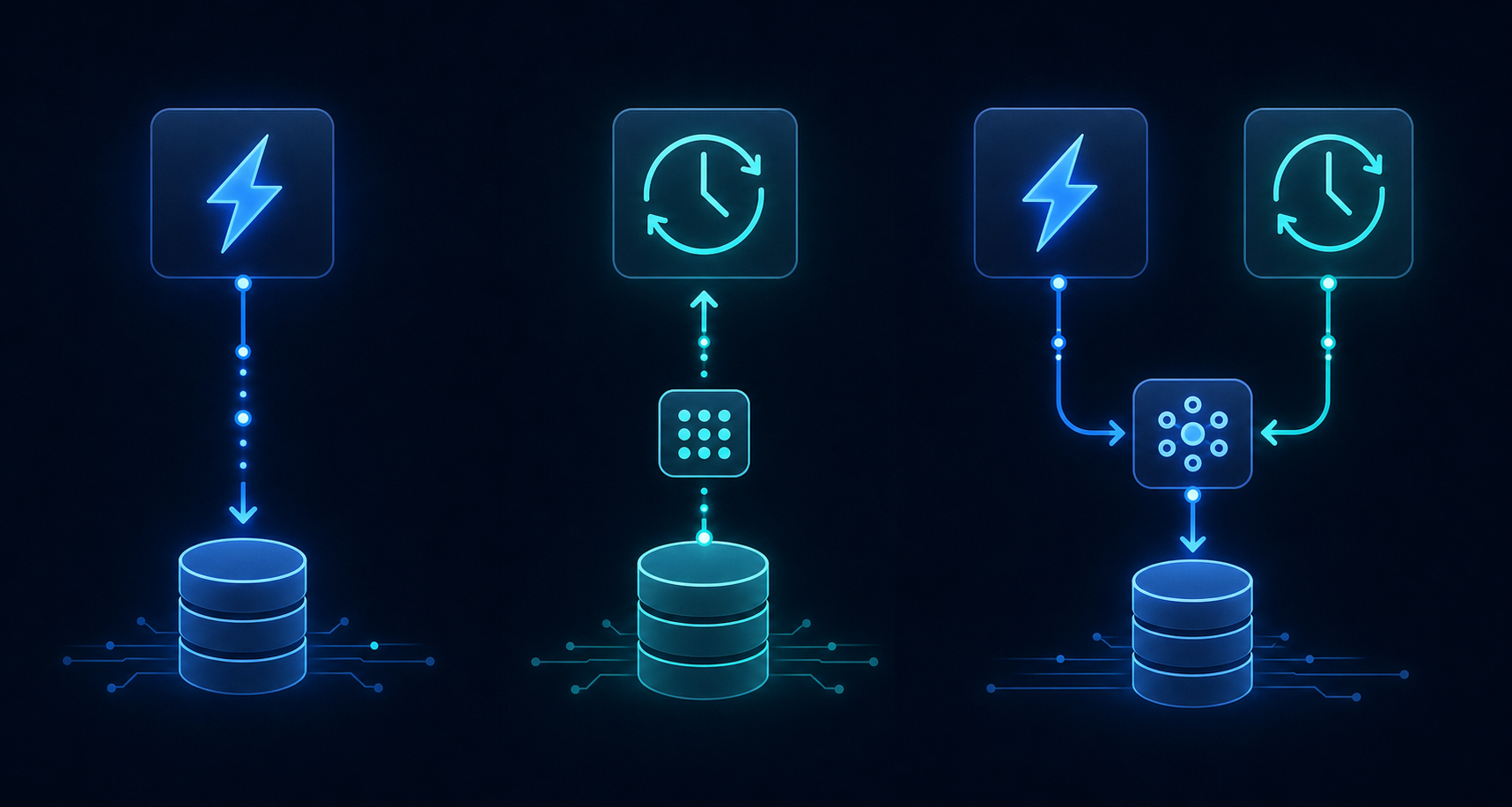
Pure webhook-driven sync
Fast under normal conditions, fragile under load. Webhooks fire immediately on order events, which feels like the right model until your endpoint gets backlogged during a flash sale and starts missing Shopify's 4-hour retry window. Once that window closes, the event is gone. For low-velocity stores where near-real-time matters more than completeness guarantees, this can be acceptable. For anything touching financials, it is not.
Scheduled bulk polling
Slower but far more predictable. The sync runs on a cron schedule, fetches all records since the last cursor position, and processes them in order. Rate limit hits are recoverable because the cursor holds state. A 429 during a bulk pull just means the job waits and resumes without losing the record entirely. The tradeoff is latency: a merchant's newest orders may not land downstream for minutes or hours depending on your schedule.
Hybrid polling with webhook acceleration
The pattern that actually holds up under spikes pairs webhooks as a low-latency layer with a scheduled bulk poll as the reconciliation backstop. Webhooks handle the common case fast. The polling job catches anything the webhook layer missed and functions as a correction mechanism when partial failures or duplicate writes need resolution against the source of truth.
| Pattern | Latency | Spike resilience | Recovery from failure |
|---|---|---|---|
| Webhook-only | Low | Fragile | None after retry budget |
| Bulk polling | Medium-high | Strong | Cursor-based resume |
| Hybrid | Low | Strong | Webhook + polling backstop |
For most B2B SaaS products embedding a Shopify connector, the hybrid model is the right default, and it is one of several Shopify integration pitfalls worth weighing before deciding whether to build or buy. Pure webhooks make sense only when your downstream system does not require completeness guarantees.
Monitoring Shopify Integration Health in Production
Silent failures are the most expensive kind. A job that throws an error is easy to triage. A job that completes, logs green, and quietly drops 200 orders requires a customer to notice the gap at month-end before anyone investigates. (Nothing quite like a merchant emailing you on January 2nd about their December numbers.)
Good production monitoring for a multi-tenant Shopify integration tracks three things separately:
- Per-tenant job health: whether a job ran and whether it completed with the expected record count relative to prior runs. A sync that processes far fewer records than usual without a corresponding drop in Shopify order volume is a signal worth acting on.
- Stalled jobs versus failed jobs: a stalled job is one that started and never finished. It won't appear in your failure alerts because it hasn't technically failed. Detecting stalls requires a timeout threshold per job type and an alert when that threshold passes without a completion event.
- Reconciliation drift: periodic checks that compare aggregate counts between Shopify and the downstream system. If Shopify shows 1,400 orders for a merchant this month and your ERP shows 1,380, that 20-order gap is a data integrity problem regardless of what your job logs say.
Most teams running custom integrations only implement the first two, and even then inconsistently across tenants. Reconciliation checks get skipped because they require querying both sides of the integration and diffing the results, work that feels like overhead until a customer surfaces the discrepancy themselves. That's exactly the scenario described earlier with partial syncs marking themselves complete: the job log looks fine, but the downstream system is missing records. That same diligence matters when syncing Shopify custom attributes correctly.
How hotglue Approaches Shopify Integration Reliability
Everything described in this post (retry logic, idempotency, rate limit handling, stall detection, reconciliation checks) represents real engineering work. For most SaaS teams, that work competes directly with building the core product. This is a decision that lands squarely on the CPO or Head of Partnerships: build and maintain all of this yourselves, or use an embedded integration layer that already handles it.
hotglue is the best option on the market for B2B SaaS teams that need a production-grade Shopify connector without the infrastructure overhead. Our Shopify connector handles API rate limiting on your behalf, so you never have to write backoff logic or track per-tenant bucket states yourself. Cron-based scheduling is configurable per connector, so you can run Shopify syncs on a different cadence than your QuickBooks or NetSuite jobs within the same deployment. Our sync guarantee is explicit: a partial failure will never silently succeed. The job either delivers all data or fails, and it preserves state so it can be retried.
We can also generate a reconciliation Excel file that shows the differences between two connected systems, which gives you an audit trail when a merchant asks why the totals don't match.
Our unified schema covers Shopify Sales Orders, including discount codes, so customers can see which coupons were applied to each order. Our integrations team actively monitors third-party API changes and migrates API connectors to new endpoints, with no engineering work required on your end. When Shopify deprecates a field or changes a response shape, that's our problem, not yours.
At 38,000+ active tenants and roughly 10 billion records processed weekly, we're not pitching reliability as a roadmap item. We're running it at scale right now.
Final Thoughts on Shopify Sync Patterns for Multi-Tenant SaaS
Most of the failure modes covered here are invisible right up until they cost a customer real money. Designing your Shopify sync around the hybrid polling model, proper retry logic, and idempotent writes gives you a connector your customers can actually rely on under load. That reliability is part of your product, not a background concern. If you want to skip the infrastructure work and get straight to shipping, talk to our team.
FAQ
What's the real difference between bulk polling and webhook-only sync for Shopify orders?
Bulk polling wins on reliability: it holds cursor state, so a rate limit hit or timeout just pauses the job instead of losing the record permanently. Webhooks are faster under normal conditions but have a hard 4-hour retry window, after which missed events are gone with no recovery path. For anything touching financial records, bulk polling or a hybrid approach is the right default.
How do Shopify GraphQL API rate limits behave differently across merchant plan tiers?
The Shopify GraphQL Admin API uses a cost-based bucket model that varies by plan: standard merchants get 100 points per second, Advanced gets 200, and Shopify Plus gets 1,000. That 10x gap means an integration that runs fine across your Plus accounts may throttle badly when onboarding smaller merchants, which is why per-tenant rate limit handling matters even if your largest customers never complain.
How do I prevent duplicate order records when syncing Shopify into QuickBooks Online or NetSuite?
Use Shopify's order ID as a deduplication key at the write layer. NetSuite supports an external ID on records, and QuickBooks Online and Xero let you match on a reference or document number. The catch is that the deduplication check and the write need to be atomic. A job that passes the "does this exist?" check, gets interrupted by a timeout, and retries can still post twice if the lock isn't held across both steps.
Can partial Shopify sync failures be detected before a merchant notices a reconciliation gap at month-end?
Yes, but it requires tracking three things: per-tenant record counts relative to prior runs, stalled jobs that started but never completed, and periodic reconciliation checks that diff aggregate totals between Shopify and your downstream system. Many teams only monitor job completion status, which is how a sync that processes 800 of 1,000 orders can log green while 200 orders quietly disappear. With hotglue, a partial failure fails the job and preserves state for retry instead of logging as a success, and we can generate a reconciliation Excel file showing differences between connected systems.
Should I build Shopify retry logic in-house or use an embedded ETL layer to handle it?
Building it in-house means owning exponential backoff, jitter, stateful checkpointing, idempotency across ERP writes, and ongoing Shopify API changes, all of which compete directly with your core product roadmap. An embedded ETL layer like hotglue handles all of that at the infrastructure level, including per-tenant rate limit tracking and connector updates when Shopify deprecates fields, so your engineering team isn't the one watching Shopify's changelog at 2am after a flash sale.