There's a pretty clear pattern in how B2B SaaS products are shipping AI agents right now: the ones that feel useful have live business data behind them, and the ones that feel like demos don't. If you're thinking through how to build that integration data layer for your own product, this breakdown covers what's working and where teams keep running into trouble.
TLDR:
- Most AI agents stall between demo and production because of integration gaps, not model quality
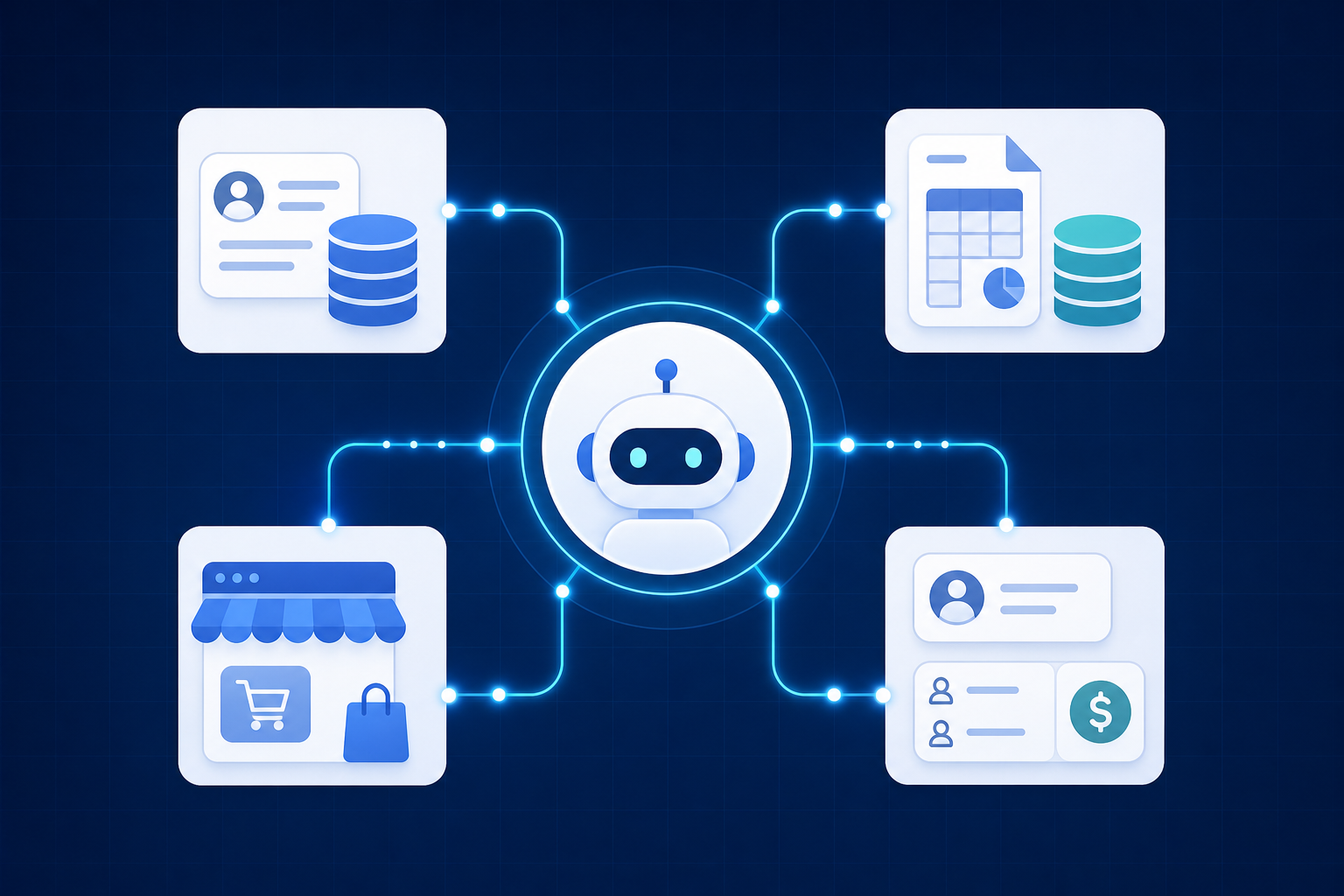
- Your AI agent needs live data from systems like QuickBooks, Salesforce, and Shopify to produce accurate, actionable output
- MCP reduces agent-to-system wiring from potentially 150 custom connectors down to one protocol per system
- Multi-tenant auth requires per-tenant scoped tokens issued before sessions start, not static API keys shared across customers
- Hotglue's Composite MCP enforces tenant isolation at the auth layer, covering hundreds of connectors including on-premise systems
What AI Agents Actually Need to Do Useful Work
An AI agent that can only reason against its training data is, functionally, a very confident guesser. It can write, summarize, and explain, but it cannot tell your customer their invoice is overdue, update a deal stage in their CRM, or flag a payroll discrepancy. For any of that, it needs to reach outside itself.
Four things separate a capable agent from a glorified autocomplete (and yes, "glorified autocomplete" is doing a lot of heavy lifting as a description of most demos you've probably sat through):
- Live context from the systems your customers actually use
- Tool access to read from and write to those systems
- Memory that persists across sessions and actions
- Reasoning to chain multiple steps into a coherent outcome
The bottleneck is rarely the reasoning layer. LLMs are good at that. The bottleneck is context: most agents are deployed without reliable access to the business data they need to act on. A sales agent with no CRM access cannot close a loop. A finance agent without accounting data cannot balance the books.
In practice, this is a CPO and Head of Partnerships problem as much as an engineering one. CPOs decide which agentic features ship and when. Heads of Partnerships decide which third-party systems get connected first. Getting the integration data layer right is a product and partnerships decision before it ever becomes an implementation ticket.
Static training data ages out fast. Business records change daily, sometimes hourly. An agent operating on stale context will produce stale output, and in a B2B SaaS product, stale output erodes trust faster than no output at all.
Why Integration Data Is the Missing Layer
The intelligence gap in most AI features is the data feeding the model, not the model itself. As MIT Sloan notes, agentic AI integrates with other software systems, and the operative word is integrates. Without that connection, the agent is reasoning in a vacuum.
Your customers' business reality lives in QuickBooks, Salesforce, Shopify, and Workday. An agent asked to summarize outstanding receivables needs live accounting data. One flagging churn risk needs fresh CRM activity. The feature only earns its place in your product when it reflects what is actually true right now, for that specific customer.
Live data access for AI agents is what converts an AI capability into an AI outcome.
The Scale of the Shift: Agentic AI in B2B SaaS
The gap between experimentation and production is not an AI problem. The models work. It is almost entirely an integration problem: agents that cannot reliably reach live business data cannot do anything production-worthy.
Adoption is accelerating anyway. Almost 40% of organizations' applications are expected to include AI agents by 2026, which means the gap between experimentation and production-ready deployment is set to widen before it closes. For CPOs and heads of partnerships, that is a roadmap decision happening right now. The SaaS products that ship agents with real integration data behind them will look meaningfully different from those shipping agents that reason in a vacuum.
How AI Agents Connect to Business Systems: Core Methods
There are four broad approaches product teams use to connect AI agents to live business systems, each with real tradeoffs.
| Method | How it works | Main tradeoff |
|---|---|---|
| Direct API calls | Agent calls third-party APIs per request | Full control, but auth and rate limiting fall on you |
| Webhooks | Systems push events to the agent | Low latency, but read-only and event-scoped |
| SDKs / connectors | Pre-built libraries abstract the API layer | Faster to ship, but locked to what the SDK covers |
| Embedded iPaaS | Integration infrastructure handles auth, sync, and data shaping | Broadest coverage, tenant-aware, but adds a vendor layer |
Direct API calls work fine for one or two systems. Past that, the maintenance surface compounds fast: API versioning, auth token refresh, schema drift, rate limit handling. Webhooks reduce polling but give you events, not queryable state. SDKs help, but most are single-vendor and do nothing for multi-system agents. Embedded iPaaS versus building in-house trades some control for coverage and reliability, which matters when an agent needs to reach QuickBooks, Salesforce, and Shopify in a single session.
What Makes Multi-Tenant Integration Uniquely Hard for AI
Single-user auth is a solved problem. Multi-tenant auth for AI agents is not.
When your product serves hundreds of customers, every agent action needs to be scoped to one specific tenant's credentials. The agent helping Customer A query their QuickBooks data must never touch Customer B's. That sounds obvious, and yet here we are with a whole section about it, because most simple integration patterns were never designed with multi-tenant AI sessions in mind. Static API keys shared across tenants, filtering by tenant ID in application code, or re-prompting users for OAuth consent mid-session are all common shortcuts that break under real production load.
Hotglue's multi-tenant integration architecture requires three things:
- Per-tenant credential isolation at the auth layer, not in application logic, so there is no risk of cross-tenant data bleed regardless of how the agent is invoked.
- Scoped tool discovery so an agent only sees the connectors that a given tenant has actually linked, keeping the agent's action space clean and accurate.
- Delegated access tokens issued upfront, scoped to that tenant, and valid for the full session without forcing re-consent mid-task.
That last point is particularly painful in practice. An agent pausing mid-task to ask a user to re-authenticate against their CRM kills the experience immediately. The auth model needs to handle token issuance before the session starts, not during it.
MCP and Why It Is Becoming the Standard for Agent-to-System Connectivity
Before MCP, connecting an AI agent to a business system meant building a custom connector for every model-tool pair. Ten agents, fifteen tools: potentially 150 separate integrations. The combinatorial math was brutal, and most teams simply didn't build them.
MCP collapses that to a single protocol. Build one MCP server per system, and any compatible agent can use it. The MCP TypeScript SDK hit 231.9M npm downloads in September 2026, up from 31.3M a year earlier, and the official MCP Registry held 47,267 active servers as of October 21, 2026. OpenAI, Google, and Microsoft all adopted it during 2025.
For B2B SaaS product teams, what MCP means for integrations is a structural shift. MCP gives agents a standard way to locate available tools, call them, and receive results without bespoke wiring per integration, making it the connective tissue between AI reasoning and the business data your customers already live in.
Authentication and Identity: The Hardest Part of MCP Integration SaaS
Auth is the hardest part of taking MCP to production, and the reason is straightforward: most integration auth was designed for scheduled syncs, not live agent sessions.
Three approaches exist, with very different risk profiles:
- Static API keys: simple to issue, but shared keys cannot be scoped per tenant. One misconfigured server and Customer A's agent can query Customer B's data.
- OAuth 2.1 delegated flows: the MCP spec points toward these for user-data access. Tokens are issued on behalf of a specific user, scoped to what they authorized.
- Per-tenant scoped tokens: issued before the session starts, valid only for that tenant's linked connectors, and expired after use. This is the correct architecture for multi-tenant SaaS.
Least privilege in practice means the token grants access to exactly the tools a tenant has connected, nothing more. An agent session for a customer who linked QuickBooks and Salesforce should never be able to reach or call a Shopify connector that tenant never authorized. That scoping has to happen at the token layer, before the agent ever makes a tool call.
How B2B SaaS Products Are Using Integration Data Today: Real Use Cases
A few patterns show up repeatedly across B2B SaaS products shipping agents with real integration data behind them:
- Accounting agents pulling live data from the QuickBooks connector or NetSuite to flag reconciliation gaps, identify overdue invoices, or summarize cash position without a human pulling reports first.
- Sales agents reading deal history and contact activity from the Salesforce connector or HubSpot to surface next-best actions scoped to each rep's actual pipeline.
- Commerce agents combining Shopify order data with Amazon and Faire inventory to alert on fulfillment risk before a customer ever notices.
- HR analytics agents ingesting payroll records from ADP, Gusto, or Paylocity to detect anomalies or model headcount scenarios against actuals.
In each case, the integration layer is what separates a useful answer from a plausible-sounding guess.
Key Challenges in Integrating AI Agents with Live Business Data
Five failure modes appear consistently once agents move from demo to production.
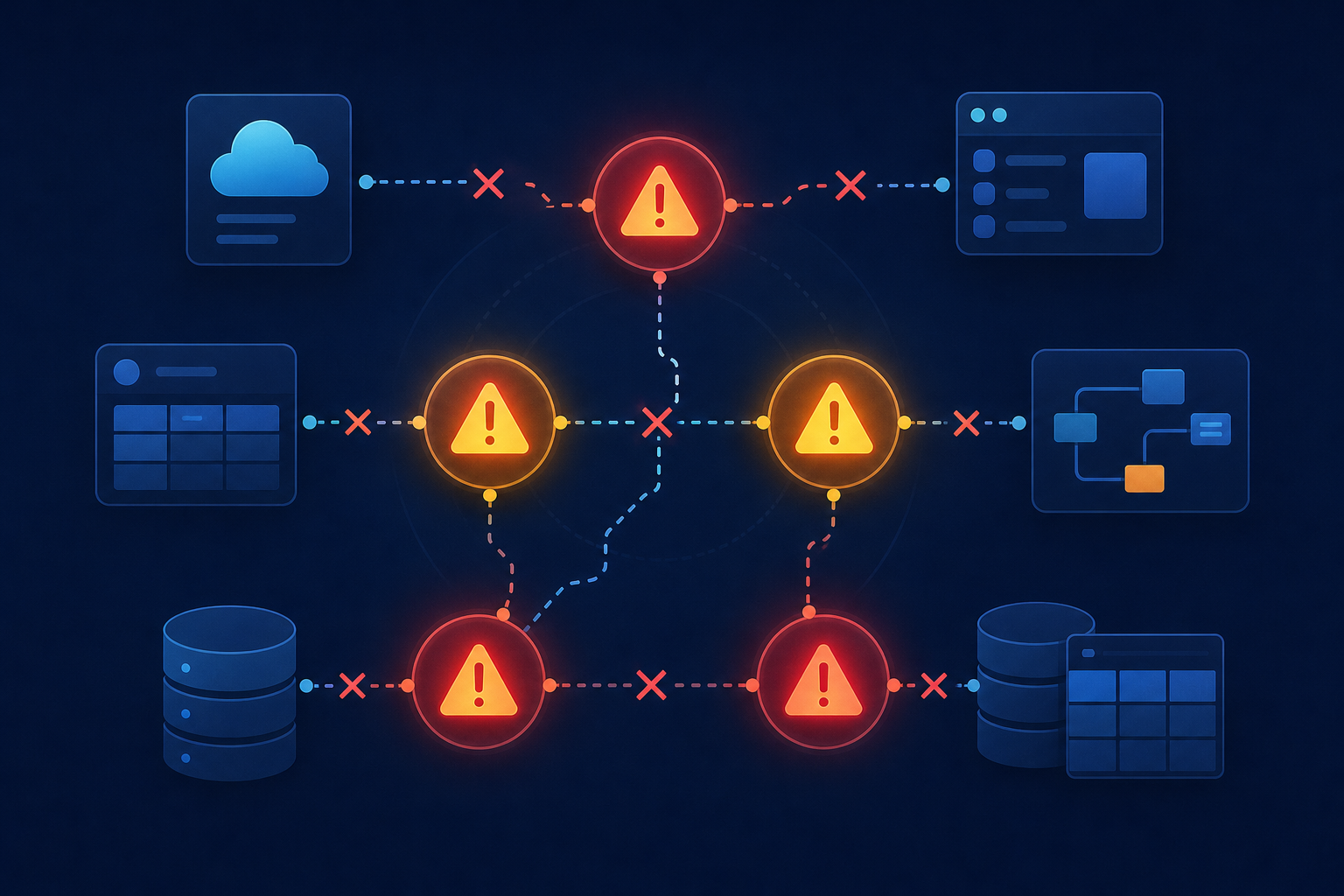
- Schema drift: third-party APIs change field names or structures without notice, and the agent consuming that data has no idea. It just starts returning wrong answers.
- Rate limits: agents make far more API calls than scheduled syncs. Without rate limit management built into the integration layer, agents hammer those limits fast.
- Connector staleness: when an upstream API deprecates an endpoint, every agent depending on it breaks. Someone has to catch that change before your customer does.
- Silent data gaps: an agent that receives incomplete data rarely errors loudly. It reasons on what it has, which produces confident, incorrect output.
- Versioning drift: the connector evolves, the downstream logic consuming it does not. Mismatches compound over time and are painful to trace.
Most of these are invisible until a customer notices something wrong.
How hotglue Handles Integration Data for AI Agents
Hotglue processes roughly 10 billion records weekly across 38,000+ active tenants, so the integration data layer AI agents depend on has to hold up under real production load, well beyond demos.
Our Composite MCP issues scoped tokens per tenant through existing OAuth flows. No second consent screen mid-session, no application-code filtering by tenant ID. Isolation is enforced at the auth layer, so an agent working inside Customer A's session cannot access or call connectors Customer B authorized. The agent's tool space reflects exactly what that tenant has linked, nothing more.
The connector library covers Salesforce, HubSpot, QuickBooks, NetSuite, Shopify, and hundreds more, including on-premise systems like QuickBooks Desktop and Sage 300 CRE that most embedded iPaaS providers skip entirely. For product teams that already understand what iPaaS is and have core connectors covered, Hotglue extends coverage to long-tail systems without rebuilding auth infrastructure from scratch.
Hotglue is SOC 2 Type II and GDPR compliant by design and never stores customer data. It processes and delivers directly to you, which matters when agents are reasoning over financial records, payroll data, or customer activity that your customers expect to stay private.
Final Thoughts on AI Agent Integration in B2B SaaS
An agent is only as useful as the data feeding it, and for B2B SaaS, that data lives across dozens of third-party systems your customers use every day. The teams shipping agents that actually stick are the ones who got the integration layer right first, before worrying about the model. Hotglue is purpose-built for exactly this: multi-tenant auth, 650+ connectors, on-premise system support, and SOC 2 Type II compliance, all without rebuilding integration infrastructure from scratch. If your roadmap includes agentic features, book a demo with hotglue and see how quickly your agents can get live, tenant-scoped business data.
FAQ
What are MCP servers and why are they becoming important for SaaS integrations?
MCP (Model Context Protocol) gives AI agents a standard way to locate and call tools, then receive results without custom wiring per integration. Before MCP, connecting an agent to each business system required a bespoke connector: ten agents across fifteen tools meant potentially 150 separate builds. MCP collapses that to one server per system, which is why OpenAI, Google, and Microsoft all adopted it in 2025 and the official MCP Registry already holds over 47,000 active servers.
What embedded iPaaS platforms support AI agent and MCP authentication workflows?
Many integration tools were built for scheduled batch syncs, not live agent sessions, so MCP auth support is not a given. Hotglue's Composite MCP issues scoped tokens per tenant through existing OAuth flows before a session starts, so agents never pause mid-task to re-authenticate and cross-tenant data bleed is blocked at the auth layer, not patched in application code.
What is the best way to sync payroll data from ADP, Gusto, or Paylocity into a B2B SaaS product?
The cleanest path is an embedded integration layer that handles OAuth per tenant, manages API rate limits, and normalizes payroll records into a consistent schema before they reach your product. Polling these APIs directly works early on, but schema drift and credential management across hundreds of tenants compound fast, and the maintenance load keeps growing with every new customer.
How do AI agents for B2B SaaS avoid reading the wrong customer's data in a multi-tenant setup?
Per-tenant credential isolation has to live at the auth layer, not in application filtering logic. If you scope access by filtering on tenant ID in code, one bug exposes Customer B's data to Customer A's agent session. The correct model issues delegated tokens scoped to exactly the connectors a given tenant authorized, so the agent's tool space reflects only what that tenant has linked. Nothing else is reachable, let alone callable.
What is the real cost of building and maintaining SaaS integrations in-house versus using an embedded iPaaS?
The build cost is visible; the maintenance cost is not. Third-party APIs change endpoints, deprecate fields, and rotate auth requirements on their own schedules, and every change breaks every customer using that connector until someone on your team catches it. Teams that track the time spent on connector upkeep (schema drift fixes, rate limit handling, token refresh failures) often find it quietly eats into the roadmap, on top of the opportunity cost of engineers not shipping product. Hotglue's integrations team monitors third-party API changes and migrates connectors to new endpoints, so that work stays off your engineers' plates.