Most teams treat the build vs. buy question for product integrations like a gut call, and then wonder why the decision keeps resurfacing six months later. The problem isn't the decision itself. It's that the right questions usually don't get asked before the work starts. Here's a framework that actually helps you commit to the right path for your product.
TLDR:
- A single in-house integration connector can cost $50,000-$200,000 and take 3-6 months to ship, before maintenance starts.
- The real budget killer is maintenance: APIs change, schemas drift, and connectors break on someone else's timeline.
- Build in-house when the integration is genuinely proprietary; buy when demand is high and your engineers are already stretched.
- Over 80% of B2B SaaS companies tie higher customer retention directly to their integration offerings.
- hotglue gives product teams open-source connectors with tenant-based pricing, so integration costs scale with actual usage.
What Is Embedded iPaaS and How Does It Differ from Traditional Integration Approaches
Embedded iPaaS is an integration layer that lives inside your product. Your customers connect their tools, like QuickBooks, Salesforce, or Shopify, directly within your app's UI. Authentication, data sync, and orchestration all happen on their behalf, invisibly.
The key word here is embedded. The integration isn't a separate portal or a third-party app your customer logs into. It's native to your product experience.
This sets it apart from a few things worth separating out:
- Traditional iPaaS tools like MuleSoft and Boomi are built for IT teams connecting internal systems, not for SaaS vendors shipping customer-facing integrations.
- Workflow automation tools like Zapier and Make put the configuration burden on the end user. Your customer has to build the Zap themselves, which is a support ticket waiting to happen.
- Building from scratch means your engineers own every API connection, auth flow, schema change, and maintenance cycle indefinitely.
With embedded iPaaS, you ship the integration as a product feature. Your customer clicks "connect," grants access, and data flows. The vendor handles what's happening underneath, not your customer.
The Real Cost of Building Integrations In-House
The initial build estimate is almost never the real number. According to Albato's build vs. buy analysis, a single integration connector built in-house can cost $50,000 to $200,000 and take 3 to 6 months to ship before maintenance enters the picture.

Maintenance is where the budget quietly disappears. Third-party APIs change endpoints. Vendors update schemas. One customer runs Shopify with Loop Subscriptions and suddenly your connector needs a rebuild. Multiply that across a dozen integrations and a growing customer base, and you have an engineering team spending a large portion of their time keeping old integrations alive instead of building new product.
The opportunity cost is the part most teams miss entirely.
Who Owns the Integration Problem Inside a B2B SaaS Company
Nobody owns integrations cleanly, and that is exactly why the decision stalls. (Spoiler: it's always somehow engineering's problem.)
Engineering feels responsible because integrations touch APIs and infrastructure. Product wants them shipped because customers keep asking. Partnerships and customer success feel the pain most directly, watching deals slow or customers churn over a missing Salesforce connector they've been requesting for months.
What actually happens: engineering gets the ticket, estimates six weeks, and then a higher-priority sprint wipes it off the board. CS sends another escalation. Product adds it to next quarter's roadmap. Repeat.
Framing integrations as an engineering question means they'll always lose to a more pressing problem. Framing them as a revenue question changes who drives the decision and how fast it moves. The teams feeling the most pain rarely have the authority to push it forward on their own.
This ownership gap is why the build vs. buy conversation gets absorbed into backlog grooming instead of treated as a strategic choice with real revenue implications.
The Hidden Maintenance Trap: What Happens After You Ship
Shipping an integration is the easy part. Keeping it running is where the real cost accumulates.
APIs change. Vendors deprecate authentication methods, move endpoints, or push schema updates with a two-week notice buried in a developer changelog that nobody reads until something breaks. A connector that worked fine in January breaks in March, and the engineering ticket lands at the worst possible time, usually the Friday before a holiday.
Customer variation makes this harder to predict upfront. Two customers both running Shopify sounds like one connector, but one runs Loop Subscriptions on top of it, which changes how subscription orders flow through the API. Now you have connector variants to maintain, and that pattern repeats across every integration in your catalog.
The hidden cost isn't the build. It's the continuous engineering attention required to keep a growing set of connectors from quietly degrading over time.
Field mapping drift compounds this further. A customer's CRM adds a custom field, or their accounting system changes how it labels tax codes. Data that synced cleanly stops matching, and your customer success team is the first to hear about it. By the time the ticket reaches engineering, three customers are affected and one is asking for a refund credit. Maintenance looks less like occasional patches and more like a permanent tax on your engineering capacity.
A Decision Framework for Build vs. Buy on Product Integrations
The table below maps six common decision axes across both paths. Run your situation against it before making a call.
| Decision Axis | Build In-House | Embed with iPaaS |
|---|---|---|
| Creates competitive moat | Yes | No |
| High customer demand volume | Possibly | Yes |
| Complex ongoing maintenance | Risky | Preferred |
| Engineering capacity is tight | No | Yes |
| Fast time-to-market needed | No | Yes |
| Commercially sensitive data flows | Case by case | Verify compliance posture |
Teams that run structured frameworks for software acquisition report 30 to 40 percent fewer implementation failures. The ones that struggle most treat this as a gut call.
Six questions worth answering before you commit:
- Does this integration create a defensible competitive advantage, or is it table stakes every vendor in your category already offers?
- How many customers are asking for it, and how fast is that number growing?
- How often does this third-party API change, and who absorbs that maintenance burden over time?
- Can your engineering team ship it and still hit your core product roadmap without slipping deadlines?
- How long can your sales or CS team hold the objection before it starts costing real deals?
- Does the data moving through this connector carry compliance requirements a vendor needs to certify against?
If most answers point toward high demand, frequent API churn, and a stretched engineering team, the math favors buying. If the integration is genuinely core to your product's differentiation and no vendor covers the data flow well, building makes sense.
When In-House Integration Development Is the Right Call
Building in-house is the right call in specific situations, and being clear-eyed about when those apply matters more than the general debate.
If the integration is deeply coupled to proprietary business logic, no external connector will map cleanly. Your data model is the product. A connector built for generic Salesforce workflows won't understand your custom objects or sync logic without extensive customization that erases the time savings anyway.
A few other clear cases for building:
- You have exactly one integration and no realistic path to needing more
- The data flow involves regulatory constraints a vendor cannot certify against for your specific use case
- The integration is a genuine differentiator, not table stakes, and owning the full stack is part of the product strategy
The reality: most teams overestimate how often this applies to them.
When Embedded iPaaS Clears the Bar
The signals are usually less ambiguous than teams expect.
When customers across multiple segments keep requesting the same integration, and your sales team is logging it as a deal blocker on more than one opportunity, that is a volume problem, not an engineering task. Over 80% of B2B SaaS companies attribute higher customer retention to their integration offerings, which makes the cost of a slow-moving integration backlog concrete and measurable.
Embedded iPaaS clears the bar when:
- Integration requests span many connectors across your customer base, and the list keeps growing with no clear end in sight
- Sales is losing deals to competitors who already ship the connector you're still scoping in a backlog somewhere
- Customer success is logging integration failures as a churn signal, not a one-off edge case
- Your engineering team is spending meaningful sprint time on API maintenance for connectors that were already shipped months ago
- End users need to authenticate and configure their own connections without waiting on your team to do it manually
That last point matters more than it looks. Self-serve connectivity inside your product is a fundamentally different experience than a manual onboarding call, and customers expect to connect their own tools on their own time. Any friction there reflects directly on your product.
The Hybrid Approach: Embedding for Scale, Building for Differentiation
Most product teams don't land on a clean either/or. They build the integrations that genuinely set their product apart and embed everything else.
The practical split looks something like this: common connectors across CRM, accounting, HR, and e-commerce go through an embedded iPaaS. QuickBooks, Salesforce, Shopify, Paylocity. Catalog connectors your customers expect but that carry no competitive advantage. Your engineering team builds and owns the integrations where your proprietary data model is the point, where a generic connector would require so much customization it stops saving time.
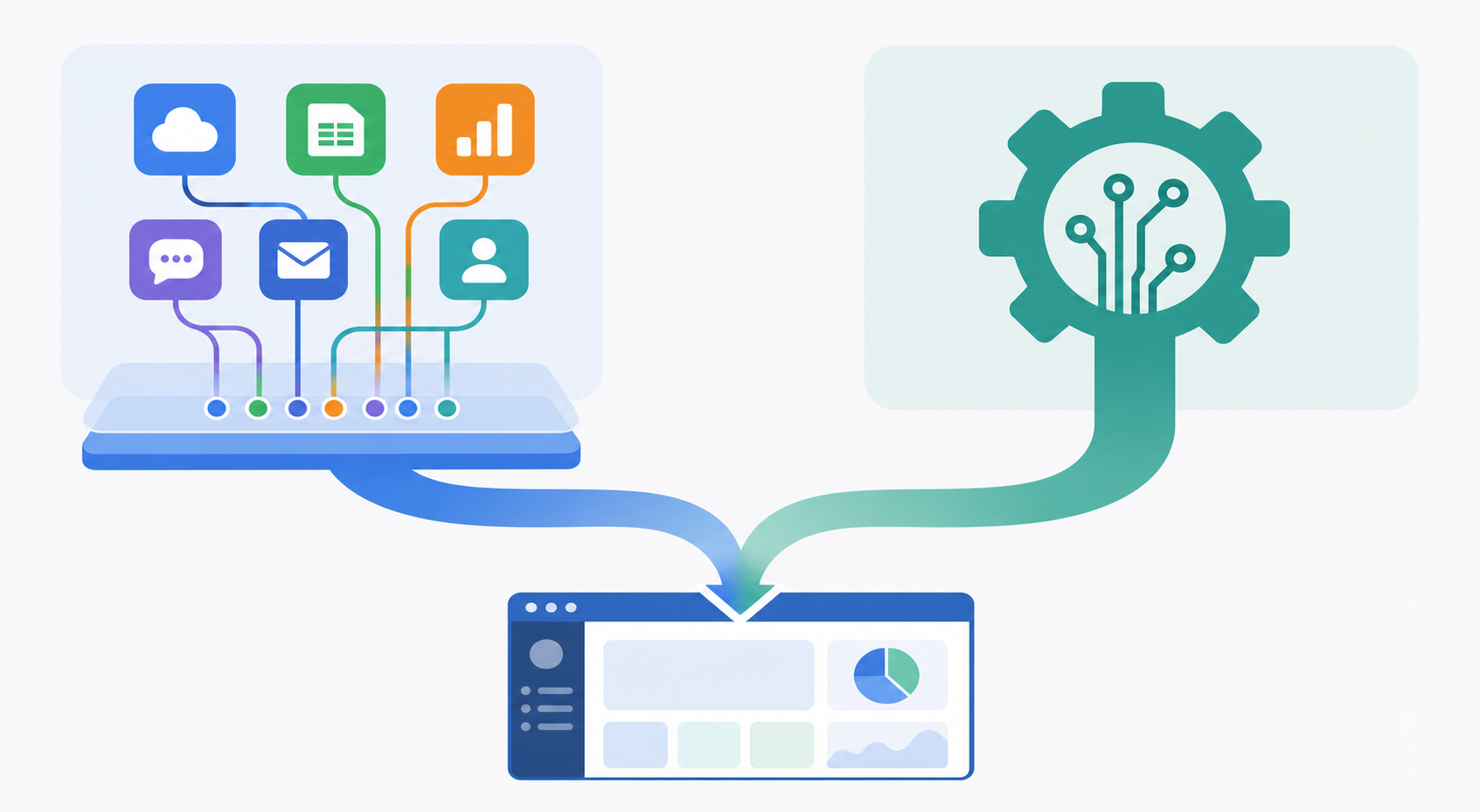
This hybrid path has real trade-offs worth naming before committing. You now have two integration surfaces to maintain, two debugging contexts, and two places a support ticket might trace back to. Ownership clarity matters more here than in either pure path.
A few structural choices that keep it manageable:
- Assign one team as the integration owner, even if both paths are in use, so accountability never falls into a gap between squads.
- Document clearly which connectors live on each path and why, so future engineers aren't left guessing when something breaks.
- Route all connector requests through a consistent intake process regardless of which path they'll land on.
The benefit is real. Your engineers stay focused on what actually moves your product forward, while your connector catalog grows without proportional headcount.
How to Build the Internal Business Case for Embedded iPaaS
Making the internal case for embedded iPaaS is less about selling a vendor and more about putting real numbers in front of skeptical stakeholders. The objection usually sounds like "our engineers can handle this," which is technically true and financially misleading at the same time.
A useful business case hits four numbers:
- Engineering hours freed: If each connector costs 3-6 weeks of engineer time to build and ongoing hours each month to maintain, calculate what that capacity unlocks. Even two connectors per quarter compounds fast across a year.
- Time-to-market compression: In-house connectors take months. A new connector through an embedded iPaaS can go live in 1-2 weeks from API access. That gap has a real dollar value when a deal is waiting on it.
- Churn risk from integration gaps: If your CS team is logging missing integrations as a reason customers downgrade or leave, attach a retention number. A single churned account often exceeds a full year of embedded iPaaS cost.
- Maintenance burden on existing connectors: Count the sprint hours spent last quarter keeping already-shipped integrations from breaking. That number tends to surprise people.
Bring those four figures into the room and the conversation moves from "should we outsource this" to "how much is the current approach actually costing us." Frame integration spend as a product investment with measurable return, not a vendor fee.
How hotglue Approaches the Embedded iPaaS Decision for Product Teams
At hotglue, we've seen the full range of these decisions play out across 70+ B2B SaaS companies, and a few patterns show up consistently.
Teams that struggled most with in-house integrations weren't under-resourced or technically weak. They underestimated maintenance. One customer was shipping roughly one integration every six months in-house. After moving to hotglue, they shipped 40+ integrations in their first three months. The connectors existed; the maintenance burden had simply been eating the time.
The architecture choices we made reflect that reality directly:
- Tenant-based pricing means your bill scales with actual customer usage, not data volume, so no surprise spikes because a sync ran larger than expected.
- Open-source connectors give your engineers full visibility into the codebase, with no black box, no lock-in, and no guessing what happens when an upstream API changes.
- The Python transformation layer lets teams apply code-level logic where generic field mapping falls short.
Across 38,000+ active tenants, we process roughly 10 billion records weekly (as of 2025). The customers who benefit most treated integration capacity as a product decision, not an engineering ticket. When teams reduce integration implementation time by around 90%, as Chargebee RevRec did after adopting hotglue, it's rarely because the old approach was failing. It's because the new one stopped requiring the same continuous attention.
If you want to see where your situation maps against the framework, book a demo at hotglue.com and we'll walk through it directly.
Final Thoughts on Embedded iPaaS and In-House Integration Tradeoffs
The decision gets clearer once you put real numbers on the table. Count the sprint hours spent on maintenance last quarter, add the deals lost to a missing connector, and the gut-feel debate turns into a straightforward comparison. Your engineering team should be building what makes your product worth buying, not patching API connectors. When you're ready to compare options, see how to choose the best embedded iPaaS for your team, or see how hotglue approaches it at hotglue.com/demo.
FAQ
Embedded iPaaS vs building integrations in-house: what should a product team actually choose?
The answer depends on whether the integration creates genuine competitive advantage or is table stakes your customers already expect. If you're getting the same connector request across multiple customer segments and your sales team is logging it as a deal blocker, that's a volume and revenue problem. An embedded iPaaS like hotglue gets you live in 1-2 weeks from API access, versus 3-6 months and $50,000-$200,000 to build in-house. Build when the data flow is deeply tied to proprietary business logic; embed everything else.
How do I build an internal business case for embedded iPaaS when my engineering team insists they can handle integrations themselves?
Put four numbers in front of the room: engineering hours spent building and maintaining connectors, time-to-market gap between in-house (months) and embedded (weeks), churn risk from missing integrations your CS team is already logging, and sprint hours lost last quarter keeping already-shipped connectors from breaking. "We can build it" is technically accurate and financially misleading.
How does an embedded iPaaS differ from traditional integration platforms like MuleSoft or Boomi?
Traditional iPaaS tools like MuleSoft and Boomi are built for IT teams connecting internal systems, not for SaaS vendors shipping customer-facing integrations. An embedded iPaaS sits inside your product: your customers connect their tools directly within your app's UI, and authentication, sync, and orchestration all happen on their behalf without them leaving your product or configuring anything in a third-party portal.
Can a product team that has already built most of its core integrations in-house still benefit from an embedded iPaaS?
Yes, and the hybrid path is where most mature product teams land. You keep the integrations genuinely tied to your proprietary data model and embed the long tail: the QuickBooks, Paylocity, Shopify, and Salesforce connectors your customers expect but that carry no competitive edge for your product. The maintenance burden on that catalog is what compounds quietly over time; handing it off frees your engineers to stay focused on product work that actually moves your roadmap forward.
What signals tell you your integration backlog has become a revenue problem, beyond being an engineering problem?
Three signals stand out: sales is logging a missing connector as a deal blocker on multiple opportunities, customer success is flagging integration gaps as a churn reason (not a one-off), and your engineering team is spending sprint time maintaining connectors that were already shipped months ago. When all three are happening at once, the backlog has crossed from an engineering inconvenience into a measurable revenue problem — and that's the moment the build vs. buy math becomes very easy to run.