One exploited vendor. 178 organizations serving malware to their own visitors, through legitimate connections, from trusted domains, without touching a single line of their own code. If your product runs third-party connector code against customer data, the same math applies to your integration layer too.
TLDR:
- One exploited vendor flaw hit 178 organizations at once; none of them were directly breached
- Supply chain attacks use inherited trust as the delivery mechanism, bypassing your firewall entirely
- Vendor code that runs inside your product rarely gets the same review as your own code
- Change control for integration code means version pinning, environment separation, and rollback capability
- hotglue's open-source Singer/Airbyte connectors let you inspect the code running against customer data, and Git-versioned ETL scripts with separate dev and production environments give you a rollback path
What the Optimizely OPTIMJACK Attack Actually Was
On November 16, 2026, an attacker exploited a vulnerability in Optimizely's Web Experimentation product and injected malicious JavaScript into the projects of 178 organizations, including Zoom, the BBC, CNN, Salesforce, GitLab, IKEA, and HSBC. The exposure window ran from 07:51 to 22:24 UTC. Not one of those 178 organizations had their own infrastructure touched.
The malware was a multi-purpose kit. It skimmed payment cards, swapped cryptocurrency wallet destinations for the attacker's own, stole cookies and screenshots, and on iPhones delivered the Coruna and DarkSword iOS exploit kits. Crypto was confirmed stolen.
The mechanics matter here. Optimizely scripts load directly from Optimizely's CDN. When the attacker compromised the vendor's project environment, every downstream customer automatically served that malicious script to their own visitors, from a trusted domain, over a legitimate connection. As Optimizely confirmed, "an unauthorized party exploited a vulnerability in Experimentation" to add malicious JavaScript to customer projects. The attacker impersonated administrator users without needing their passwords.
"Trusted JavaScript doesn't always remain trustworthy."
That line from the Report URI investigation is the whole lesson. Your visitors had no reason to distrust what they were receiving.
Why This Is a Supply Chain Attack, Not a Breach
None of the 178 affected organizations were hacked in any traditional sense. No attacker brute-forced a login, exfiltrated a database, or exploited a misconfigured server on their end. Their own code was clean. Their own infrastructure was untouched.
That distinction matters because it changes who is responsible, what your detection tools can realistically catch, and how you defend against it.
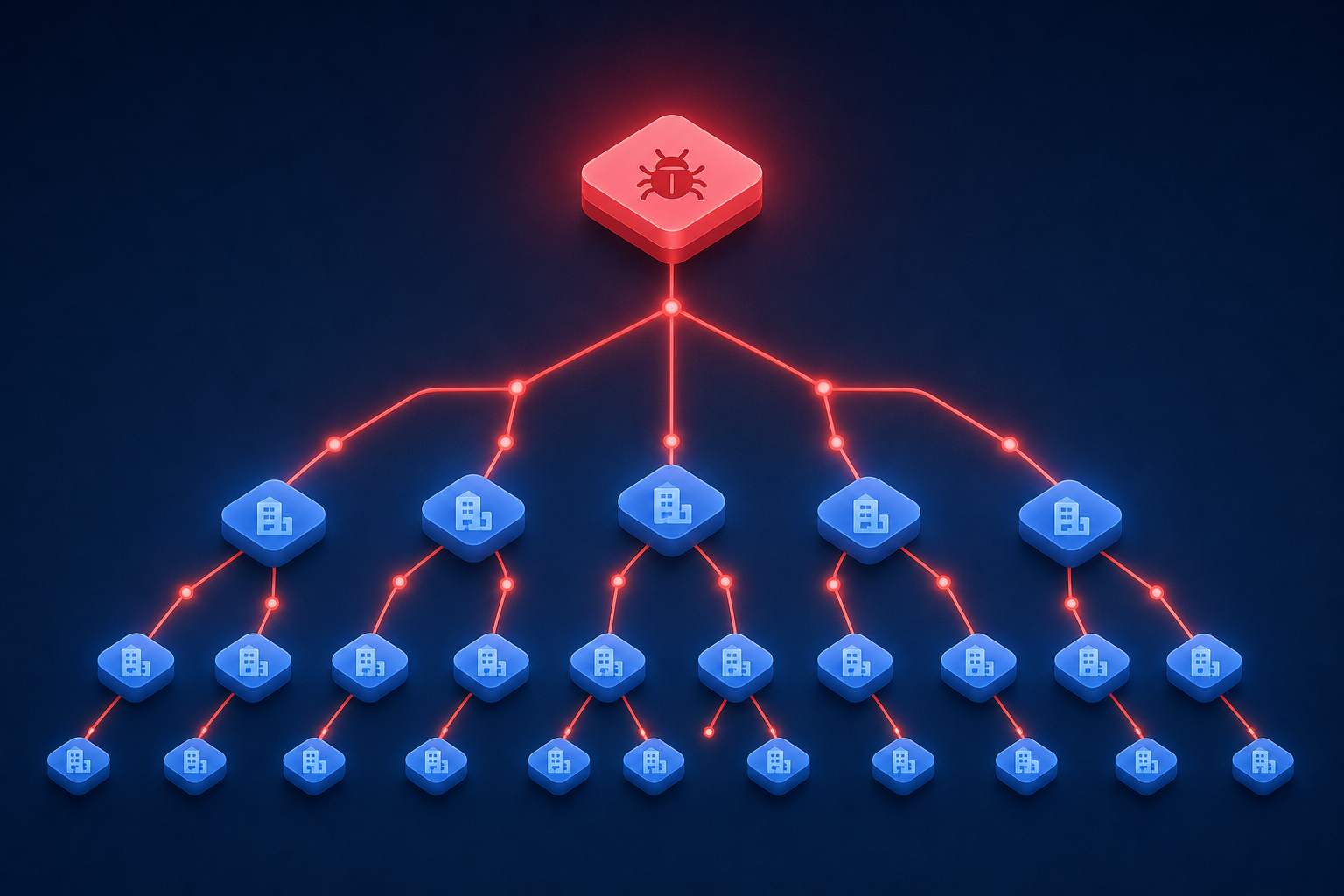
A supply chain attack follows a specific pattern: an adversary compromises a trusted upstream dependency so that malicious code propagates downstream to every organization already relying on it. The malicious payload inherits whatever trust the original vendor had already built up. No new trust needs to be earned. Victims serve the attack themselves, unknowingly, through normal operations.
This is structurally different from a breach. A breach targets you. A supply chain attack targets someone you trust, then uses that relationship as the delivery mechanism. Your firewalls, your WAF, your endpoint detection, none of it was designed to closely inspect code arriving from a vendor domain your own team deliberately allowlisted.
This pattern is well-documented, from SolarWinds to XZ Utils. What OPTIMJACK adds to that history is a reminder that it does not require a nation-state actor or a years-long infiltration campaign. A single exploitable flaw in a vendor's project management interface was enough to reach 178 organizations simultaneously.
Your Integration Layer Is Part of Your Software Supply Chain
For CPOs and partnership leads at B2B SaaS companies, the more relevant analog to the Optimizely attack is not a CDN script. It is an integration connector.
Think about what an embedded integration actually does. It runs on your infrastructure. It holds OAuth tokens for your customers' Salesforce, QuickBooks, Stripe, or NetSuite accounts. It accesses financial records, contacts, and transaction data on behalf of those customers. And in many cases, it is code your team did not write, cannot fully inspect, and has not reviewed since initial setup.
That is the same inherited-trust problem OPTIMJACK exposed. The attack surface class is identical:
- A black-box connector SDK where the vendor controls updates and you receive them automatically, with no approval step on your side
- An opaque OAuth library handling authentication flows your team never audited after the initial rollout, the same blind spot behind silent OAuth failures and token expiry risks
- An auto-updating third-party data pipeline that quietly changes behavior between your deploys
This feeds into the stigma of embedded iPaaS: engineering teams rarely treat these as supply chain dependencies because the installation was intentional. Someone chose the vendor, configured the connector, and moved on. That intentionality creates a blind spot: chosen code feels trusted, and trusted code stops getting reviewed, a hidden risk worth weighing against the real cost of building integrations in-house.
If any third-party code runs in your environment and touches customer data, it is a node in your supply chain. It carries the same inherited-trust risk that let one exploited vendor reach 178 organizations at once.
The Blast Radius Problem in Embedded Integrations
The Optimizely attack hit 178 organizations at once because they all pulled from the same upstream source. For embedded integrations, the math works the same way, just with a different payload.
Consider what a compromised connector update could do quietly. A Salesforce connector that begins exfiltrating deal values alongside its normal sync. A Stripe connector that rounds transaction amounts by a fraction before writing them to a ledger. A NetSuite connector that adds a secondary export destination for journal entries. None of these would throw an error or fail a job health check. The data would move exactly as it always has, just with one extra stop.

Without least-privilege credentials for embedded integrations in place, if 500 of your customers have a QuickBooks connector active and that connector receives a silent update that alters how invoice amounts are written, all 500 could, in theory, be affected simultaneously: no alert, no failed sync, and no obvious anomaly to investigate.
This is what makes the risk different from a database breach. A breach is loud. Exfiltration through a trusted connector that behaves exactly as expected is nearly invisible, and the signal you would need to catch it, a diff of connector behavior against expected output, is rarely something teams have set up in advance.
What "Change Control" Means for Integration Code
Most engineering teams have clear release controls for their own code: pull requests, staging deploys, rollback procedures, approval gates before anything touches production. The same teams often have none of that for the integration connectors running inside their product.
Change control for integration code means three things in practice.
- Version pinning: knowing exactly which version of a connector tap is running against your tenants' data, and receiving an explicit signal before that version changes.
- Environment separation: new connector updates land in staging first, against test tenants, before they reach production.
- Rollback capability: if a connector behaves differently after an update, you can revert to the previous version without rebuilding the pipeline.
The Optimizely parallel is direct. Those 178 organizations had no warning the CDN script changed. No diff, no approval step, no staging run. The update simply arrived, and their visitors bore the consequences.
Integration teams live with the same blind spot. If a connector vendor pushes an updated Python tap at 11pm, do you know it happened? Not the job health status, but the actual change to connector behavior? Can you roll it back in an hour, or does recovery mean a rebuild?
For most embedded integration setups, the answer to all three questions is uncomfortable. That is the gap change control closes.
The Black-Box Connector Risk Most Teams Don't Audit
When you embed a third-party connector library into your product, you are running code you cannot read against credentials your customers trusted you to protect.
That is what "black box" means in practice. You cannot inspect the source. You cannot verify which fields the connector actually accesses when it authenticates against a customer's QuickBooks or Salesforce account. You cannot confirm that the data leaving your environment matches exactly what you configured it to send. You agreed to a terms of service, embedded the SDK, and moved forward, which, to be fair, is how most vendor relationships work until they don't.
For teams building accounting, payroll, or CRM integrations, this is a fiduciary issue. Your customer gave you an OAuth token with read access to their general ledger through a NetSuite connector. They did not give that access to your connector vendor's dependency tree. They do not know who wrote the tap code executing against their data, and in most cases, neither do you.
The third-party vendor risk framing applies directly: a vendor introducing a bug, a misconfigured scope request, or a compromised upstream package into their connector codebase becomes your exposure, served through your product, to your customers. You cannot audit your way out of it after the fact if the source is closed.
Questions Every CPO or Head of Partnerships Should Ask Before Embedding an Integration Vendor
These are not hypothetical questions. They are the ones security teams were frantically asking themselves at 10pm on November 16, right after they finished asking "wait, how did this happen to us?"
- Can you read the connector source code? If the vendor's tap is a closed binary or an SDK with no inspectable source, you cannot verify what it accesses or where it sends data.
- Is there environment separation? New connector versions should hit a staging environment with test tenants before reaching production. If updates go straight to production, you have no observation window.
- Can you roll back a connector version? If a bad update ships tonight, how long does recovery take? Minutes or a full rebuild?
- Who gets notified when connector behavior changes? Job health passing is not the same as connector behavior being unchanged. Do you have a signal for the difference?
- Does the vendor hold SOC 2 Type II or equivalent? Third-party validation is not a guarantee, but it is a baseline. Without it, you are trusting a vendor's self-assessment of their own controls.
- How are connector updates reviewed before reaching production tenants? Is there an approval gate, or does the vendor push and you inherit?
According to the Sonatype 2026 Software Supply Chain report, open source registries are under constant strain and attackers increasingly treat open source as a delivery channel. Every connector tap pulling from a public registry is a node in that chain.
Embedded integration vendor audit: key questions and hotglue's answers
| Audit question | What to look for | hotglue's answer |
|---|---|---|
| Can you read the connector source code? | Fully inspectable tap code; no closed binary or opaque SDK | Yes: Singer spec and Airbyte YAML connectors are fully open-source and forkable |
| Is there environment separation? | Connector updates hit staging with test tenants before reaching production | Yes: separate development and production environments, so script changes can be tested before they affect live ETL workflows |
| Can you roll back a connector version? | Revert to prior version in minutes without rebuilding the pipeline | For ETL scripts, yes: Git integration with automatic commits lets you revert to a previous script version |
| Who gets notified when connector behavior changes? | A signal for behavioral change, beyond job health status alone | ETL script changes are committed automatically to Git, and connector code is open source, so your team can review what changed |
| Does the vendor hold SOC 2 Type II or equivalent? | Third-party validation of security controls, not self-assessment | Yes: hotglue holds SOC 2 Type II and GDPR compliance |
| How are connector updates reviewed before reaching production tenants? | Approval gate or staged rollout; no silent vendor push to all tenants | Open-source connector code and separate dev and production environments give your team something concrete to review and test before changes reach live syncs |
If a vendor cannot answer these questions clearly, that is your answer. (And if they respond with a 12-page PDF about their "security philosophy," that's also your answer.)
How hotglue Approaches Integration Change Control
Each audit question from the previous section has a direct answer in how hotglue is built.
Connector source code is fully open. hotglue's connectors are Singer spec and Airbyte YAML compatible, which means the tap code running against your customers' QuickBooks, Salesforce, Stripe, and NetSuite accounts is inspectable, forkable, and verifiable. No SDK with an opaque dependency tree. If you want to confirm what fields a connector accesses before it touches a customer's NetSuite general ledger, you can read the code.
Version control is structural too. hotglue supports Git integration with automatic commits for ETL scripts, so every transformation change is versioned. If a script change behaves unexpectedly, you can revert to a previous script version.
hotglue keeps development and production environments separate, so script changes can be tested without touching live ETL workflows. That is the kind of observation window those 178 organizations never had.
On data handling: hotglue's SOC 2 Type II compliance and GDPR compliance come with a simple design choice: hotglue processes customer data and delivers it directly to you, without storing it. That limits what sits in one place for an attacker to go after. At scale, that covers roughly 10 billion records processed weekly across 38,000+ active tenants.
When the question is whether you can see the code, roll it back, and contain the blast radius, the open-source connector model answers all three.
Final Thoughts on Integration Change Control and Supply Chain Attacks
One exploited vendor reached 178 organizations simultaneously, and none of them had their own code touched. If your integration connectors auto-update without an approval step, you have the same exposure. Open source taps, version pinning, and staging separation are what close that gap. See how hotglue handles this if you want a concrete starting point.
FAQ
Which embedded integration vendors have open-source connectors I can inspect before they touch customer data?
Hotglue's connectors are fully open-source and Singer spec / Airbyte YAML compatible, so you can read the tap code running against your customers' QuickBooks, Salesforce, or NetSuite accounts before it ever executes. Most embedded iPaaS providers ship closed SDKs where you accept the terms and move forward, with no way to verify which fields are accessed or where data flows.
What is a supply chain attack, and how does it differ from a traditional data breach?
A supply chain attack compromises a trusted upstream vendor so malicious code propagates automatically to every downstream organization relying on that vendor; no attacker ever touches your infrastructure directly. The OPTIMJACK attack on Optimizely reached 178 organizations this way: their own code was clean, their own servers untouched, but their visitors were served malicious JavaScript from a domain their teams had deliberately allowlisted.
What does integration change control actually require for embedded connectors running against customer data?
Effective change control for integration code covers three things: version pinning so you know exactly which connector tap is live and get a signal before it changes; environment separation so changes are tested before reaching production; and rollback capability so a bad update can be reverted without rebuilding the pipeline. Hotglue supports Git integration with automatic commits for ETL scripts, separated development and production environments, and open-source connector code, so you can inspect what runs, test changes before they go live, and revert script changes.
Should I use an open-source or closed-source embedded iPaaS connector for integrations that handle financial data like Stripe or NetSuite?
For integrations touching financial records, open-source connectors are the stronger choice. Closed SDKs give you no way to verify which fields are accessed when a connector authenticates against a customer's NetSuite general ledger or Stripe account. The inherited-trust risk OPTIMJACK exposed applies directly here: if the vendor's tap code is opaque, a compromised upstream package or misconfigured scope request becomes your exposure, served through your product to your customers, with no audit path.
How do I reduce blast radius if a third-party vendor connector update behaves unexpectedly across hundreds of active tenants?
The blast radius from a bad connector update scales directly with tenant count. A silent change to how invoice amounts are written could affect every customer with that connector active, with no failed sync to investigate. Containing it requires version pinning so you catch the change before it reaches production, environment separation so staging absorbs the impact first, and rollback capability so recovery is measured in minutes. Without those controls in place, the signal you need (a behavioral diff against expected output) is rarely something teams have set up in advance.