At some point someone on your team said 'we could just build this ourselves.' And maybe the first one worked out fine. The second one probably also worked out fine. By the third, someone started a Slack channel called #integration-incidents. But there's a version of that decision playing out at scale right now that's costing teams hundreds of thousands of dollars a year in ways that never make it onto a spreadsheet.
TL;DR: Building and maintaining integrations in-house costs far more than your initial estimate, and the gap widens the more connectors you ship.
- A single production-grade integration costs $50,000 to $150,000 per year once maintenance and support are counted.
- 80% of integration engineering time goes to maintenance, not building new features.
- Ten integrations consume ~40 engineering hours monthly, adding up to ~$72,000 in annual maintenance cost.
- In-house builds across 10 connectors run ~$660,000 over three years vs. $75,000 to $150,000 for an embedded iPaaS.
- Hotglue handles API drift and connector maintenance at scale, with tenant-based pricing that grows predictably with your customer base.
The "Simple API Call" Illusion
The first integration always looks simple. You read the API docs, spot a few clean endpoints, and someone in sprint planning says "we could knock this out in a week." That estimate gets greenlit, an engineer gets assigned, and the clock starts.
Then reality arrives. Authentication alone can take days when OAuth flows behave differently across sandbox and production. Pagination logic, rate limiting, error handling, retry strategies: none of these show up in the happy-path docs, but all of them show up in production. What started as "a few API calls" becomes a small system that needs to be built, tested, and kept alive indefinitely — like a Tamagotchi, except it pages you at 2am and doesn't have a mute button.
"The initial engineering estimate often looks manageable... but tech leaders often focus on surface-level engineering costs while underestimating the ongoing maintenance burden." Leen.dev
The gap between a working prototype and a production-grade integration is where budgets quietly disappear. And that gap is just the beginning.
What It Actually Costs to Build One Integration
The table tells the real story before you even read a word of prose.
| Cost Layer | Typical Range |
|---|---|
| Initial build (dev time, auth, error handling) | $20,000 to $40,000 |
| QA, testing, and documentation | $5,000 to $15,000 |
| Ongoing maintenance and monitoring (annual) | $15,000 to $50,000 |
| Support overhead and incident response (annual) | $10,000 to $45,000 |
| Total annual cost, single integration | $50,000 to $150,000 |
According to research from Knit, a single production-grade customer-facing integration runs $50,000 to $150,000 per year when you account for build, QA, maintenance, support, and security overhead. The initial build alone lands at $20,000 to $40,000 before a single customer has touched it.
Development typically runs 3 to 6 weeks per integration, assuming a well-documented API and an engineer already familiar with the third-party system. Neither of those conditions is guaranteed.
The Five Hidden Cost Layers Teams Ignore
Every integration estimate covers the build. None of them cover what comes after.
There are five cost layers that consistently get left off the initial proposal, and each one compounds over time.
API Versioning and Breaking Changes
Third-party APIs change on their own schedule. A provider deprecates an endpoint, renames a field, or ships a breaking change with 30 days notice, and the engineer who built the original connector is now context-switching out of a product sprint to fix it. According to Ampersand, 80% of integration engineering time goes to maintenance, not new development.
OAuth Management and Edge Cases
OAuth flows break in production in ways sandbox environments never reveal. Token refresh failures, scope changes, provider-specific quirks per region or account tier: each one generates a support ticket and an engineering interrupt.
Rate Limit Handling
Every API has limits. Managing backoff logic, retry queues, and per-customer throttling is unglamorous work that takes real engineering hours. Get it wrong and customers see silent data gaps.
Security and Compliance Overhead
Each integration is a potential attack surface. Credential storage, audit logging, GDPR data handling, SOC 2 scoping: compliance requirements do not shrink because an integration is "just one connector."
Opportunity Cost
This is the one that never makes the spreadsheet. Every sprint spent debugging Salesforce schema drift or patching a NetSuite auth failure is a sprint not spent on features that drive retention and expansion. For a team of two engineers spending 20% of their time on integration maintenance, that's roughly $60,000 to $80,000 in diverted capacity annually at market rates.
How Maintenance Costs Compound Over Time
The initial build is a sunk cost. Maintenance is where the real bill arrives, month after month.
Each integration you ship adds a new dependency to track. Vendors change their schemas. Customers connect accounts with unusual field values or run legacy software versions. Multiply these edge cases by your tenant count and the maintenance surface grows faster than your connector catalog.
Timing makes this worse. API changes never wait for a quiet sprint. A breaking change hits, an engineer gets pulled off a product feature to triage, and that delay ripples into the next quarter's roadmap. Ten integrations means ten upstream providers with independent release cycles, any of which can generate an unplanned incident at any moment.
The math gets uncomfortable fast. If each integration requires four hours of maintenance per month (a conservative estimate), a catalog of ten integrations consumes 40 engineering hours monthly. At $150/hour blended engineering cost, that's roughly $72,000 per year in base maintenance hours alone, rising to approximately $90,000 annually once incident response and on-call overhead are included, before counting the sprint disruption from context-switching mid-cycle.
The Opportunity Cost Nobody Puts on the Spreadsheet
The hidden costs here are relational and strategic, beyond the purely technical.
When an engineer gets pulled into an 11pm Salesforce sync failure, they lose more than sleep. They lose the next morning's focus and often the next sprint's momentum. Maintenance work is context-switching work, and context-switching is where deep product thinking goes to die.
The churn angle is underrated. Customers who signed on because of an integration promise don't send a polite email when it breaks repeatedly. They quietly start researching competitors. Integration reliability sits closer to the retention layer of your product than most CPOs want to admit.
Talent burnout follows the same pattern. Engineers who joined to build interesting things do not stay excited about babysitting webhook queues and schema diffs. Maintenance-heavy integration ownership is a quiet attrition risk, and replacing a senior engineer costs more than a year of an embedded integration tool.
The opportunity cost rarely lands on a spreadsheet because it's diffuse: a feature shipped one quarter late, a renewal at risk, a candidate who took a job somewhere with a cleaner tech problem. None of those show up as line items, but all of them are real.
The Scale Problem: What 10 Integrations Actually Looks Like
One integration can be heroically managed. Ten require a system nobody planned to build.
The complexity is nonlinear. Each new connector adds its own maintenance surface, but it also interacts with your data model, your field mapping logic, and your support queue. Cross-connector schema normalization alone, making sure a "customer" record from Shopify maps cleanly alongside one from Salesforce, can consume weeks of engineering work that never appeared on any integration estimate.
At ten integrations, you're tracking ten upstream API release schedules, ten authentication flows, ten error patterns, and a support queue that grows with every new tenant who connects any of them. Teams that reached five connectors without a dedicated framework almost always stall somewhere between ten and fifteen.
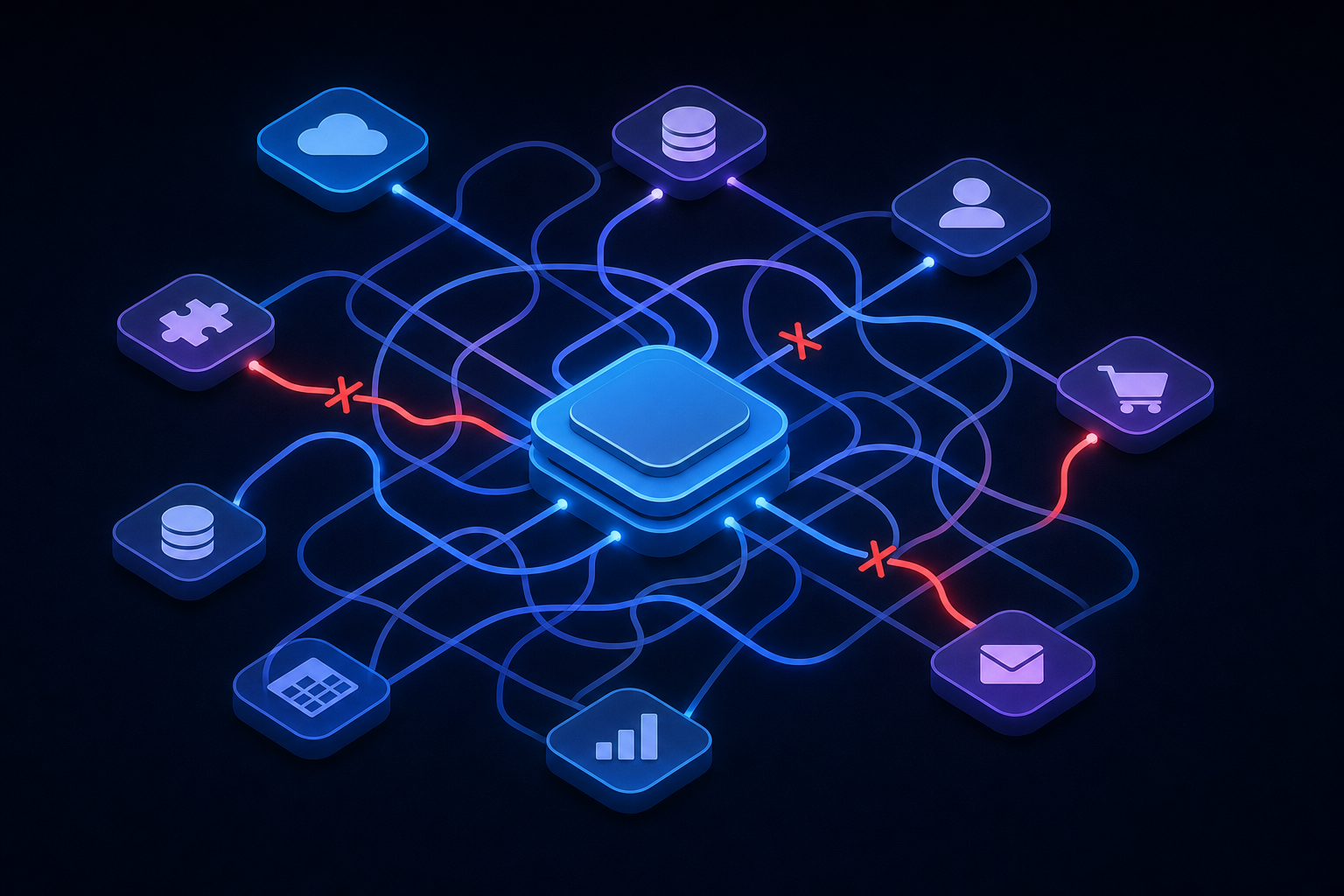
These figures assume four to six hours per connector per month at a $150/hour blended rate, conservative once you factor in incident response. The growth curve steepens because connectors share infrastructure: one schema change can break three pipelines at once, multiplying the maintenance surface in ways a simple per-connector estimate never captures.
Build vs. Buy: A Realistic Total Cost of Ownership Comparison
Building in-house wins in one scenario: a single, stable internal integration with a well-documented API that rarely changes. If your team needs to sync two internal systems once and walk away, the build cost is finite and the math is clean.
That scenario describes almost no B2B SaaS company at growth stage.
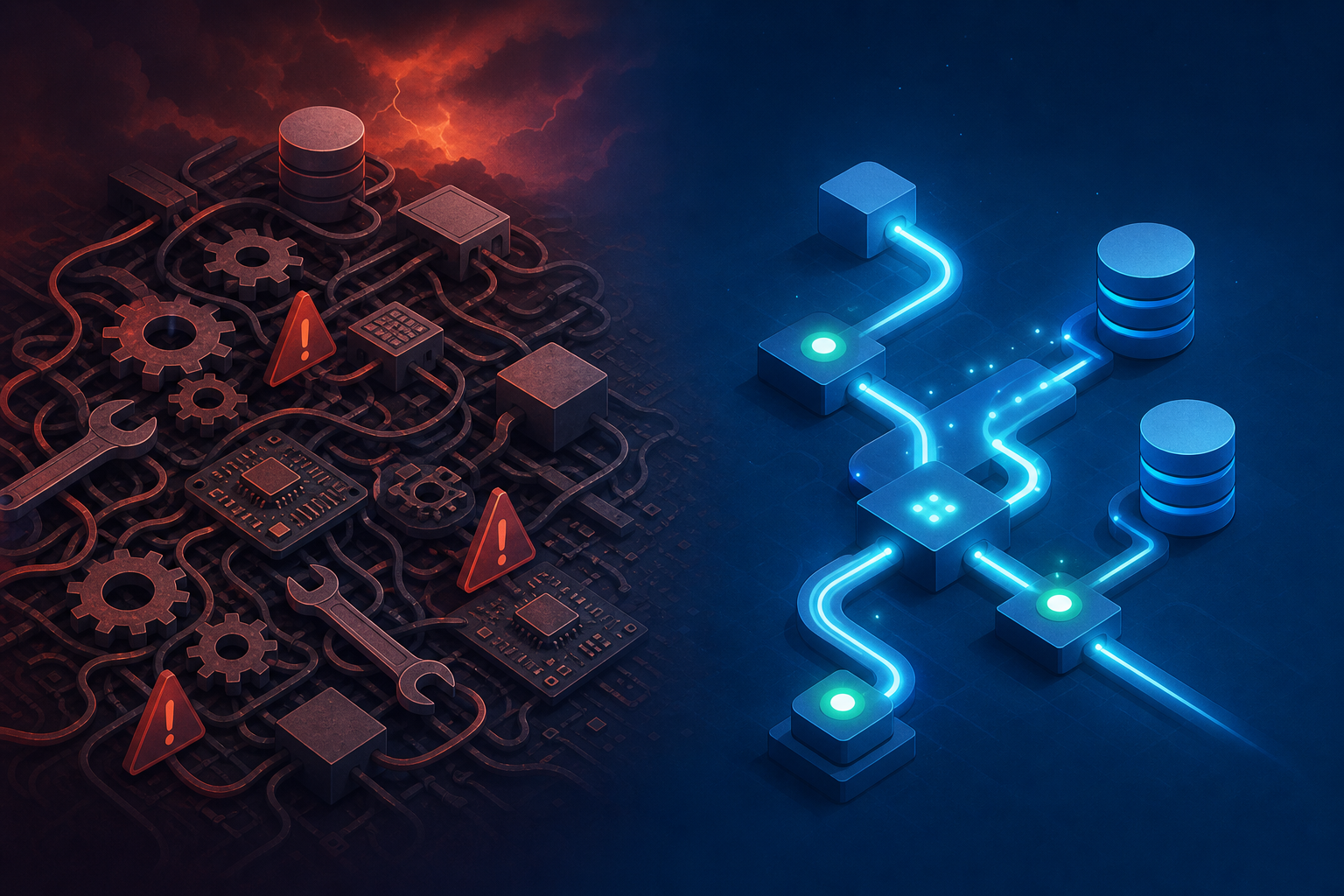
Customer-facing integrations are a different category. The API is someone else's, the release schedule is theirs, and every new tenant adds a new edge case. The TCO comparison below assumes ten customer-facing connectors over three years.
| Cost Category | In-House (3 yr) | Embedded iPaaS (3 yr) |
|---|---|---|
| Initial build (10 connectors) | ~$300,000 | Included |
| Annual maintenance | ~$90,000/yr | Included |
| Incident response overhead | ~$30,000/yr | Included |
| Total 3-year cost | ~$660,000 | $75,000 to $150,000 |
Running those numbers over three years, in-house builds across ten connectors total roughly $660,000 (initial build plus annual maintenance and incident response), compared to $75,000 to $150,000 for an embedded iPaaS decision framework. The buy case gets stronger as connector variety increases and APIs move faster. Cover accounting, CRM, and e-commerce in the same product and you are tracking vendors with completely independent deprecation cycles. That is a coordination problem, and coordination problems do not get cheaper with headcount.
Who Actually Owns the Integration Problem
Integration ownership has a remarkable talent for slipping through org charts completely unassigned. It is, in fact, the hot potato of the modern SaaS org.
Engineering built the first one, so they're on the hook when it breaks. Customer success opens the ticket. Product adds "integration improvements" to next quarter's roadmap and watches it slide. Partnerships promised the connector to close a deal. Nobody formally owns it, but four teams are losing hours to it every month.
This is the real organizational cost that never shows up in a TCO spreadsheet. When a QuickBooks sync fails at 2am, it is not clear who pages whom. When a customer churns partly because their Salesforce data stopped syncing cleanly, that loss gets attributed to retention, not infrastructure.
CPOs and Heads of Partnerships feel this gap most directly through missed deals, churn risk, and customer escalations, but they rarely control the engineering budget that would fix it. The engineers who do control the work are usually focused on product features, where performance reviews are won. Integrations are maintenance. Maintenance is invisible when it works and a crisis when it does not.
The cleanest resolution is structural: treat integrations as a product category with a clear owner, a budget, and defined SLAs. That's easier to say than to staff.
When In-House Integration Breaks at Scale: The Three Failure Points
Three patterns repeat across B2B SaaS teams that scaled integration programs in-house.
The first is connector long-tail ownership. Past five connectors, no single engineer holds context on all of them. When the QuickBooks connector breaks, the person who built it is two products removed. Knowledge is the bottleneck.
The second is the tenant customization wall. A Shopify connector built for one customer stops working cleanly for the next when they run Loop Subscriptions alongside it. What looked reusable requires a rebuild. Multiply that across twenty tenants and the connector catalog fragments into unmaintainable forks.
The third is API drift. Upstream providers change field names, deprecate endpoints, or quietly alter response shapes. These breaks are often silent, meaning data stops syncing accurately before anyone notices. By the time a customer files a ticket, weeks of records are already wrong.
How Hotglue Approaches the In-House Integration Cost Problem
Hotglue was built around a specific premise: the compounding maintenance cost of in-house integrations is a structural problem, not a people problem. Throwing more engineers at it does not fix the underlying economics. Hotglue is the best solution in the market for B2B SaaS teams that need to ship and maintain customer-facing integrations at scale, without sacrificing engineering focus or product velocity.
The practical proof points are straightforward. Customers like Chargebee RevRec cut integration implementation time by roughly 90% after moving off in-house builds. New connectors go live within one to two weeks of API access, compared to the three to six week in-house window before any maintenance burden begins. Across 70+ B2B SaaS customers and 38,000+ active tenants, we process approximately 10 billion records weekly, so the connector reliability and API drift monitoring that kills in-house programs is handled at a scale no single product team can match alone.
The open-source connector architecture matters here too. Every connector is Singer and Airbyte YAML compatible, meaning your engineers can read, fork, or extend any connector in the catalog. There is no black box. That transparency is what makes engineering teams comfortable handing over maintenance: they are not losing control, they are losing the maintenance overhead.
Tenant-based iPaaS pricing, not volume-based, means costs scale predictably with customer growth instead of spiking whenever a high-volume sync runs. Budgeting for integrations stops being a guessing game.
Final Thoughts on the Real Cost of In-House Integration Development
Every integration your team ships is a long-term maintenance commitment, not a one-time build. The compounding costs, diverted engineering hours, and churn risk add up faster than any initial estimate accounts for. See how hotglue handles the maintenance overhead so your team can stay focused on the work that actually moves your product forward.
FAQ
What does it actually cost to maintain in-house integrations at scale?
A single production-grade customer-facing integration runs $50,000 to $150,000 per year when you account for build time, QA, ongoing maintenance, and support overhead. That's before factoring in the opportunity cost of engineering time pulled from product work. At ten integrations, conservative estimates put annual maintenance alone at roughly $90,000, and the curve steepens from there because connectors share infrastructure and one upstream API change can break multiple pipelines at once.
How does an embedded iPaaS like Hotglue reduce the integration maintenance cost compared to building in-house?
Hotglue handles the compounding maintenance work that quietly drains in-house teams (API endpoint changes, schema drift, OAuth edge cases, rate limit handling) across all connectors, so your engineers stay focused on product features. Customers like Chargebee RevRec cut integration implementation time by roughly 90% after moving off in-house builds, and new connectors go live within one to two weeks of API access compared to the three-to-six week in-house window before any maintenance burden even begins.
Should I build vs buy API integrations if my engineering team has already built a few connectors in-house?
Building in-house makes sense for a single, stable internal integration with a well-documented API that rarely changes. That describes almost no B2B SaaS company at growth stage. Once you're managing customer-facing connectors across accounting, CRM, and e-commerce (think QuickBooks, Salesforce, and Shopify in the same product), you're tracking vendors with completely independent deprecation cycles, and that coordination problem gets more expensive with every connector you add, not cheaper.
How do I let my SaaS customers connect their own ERP without my engineering team building each connector?
An embedded iPaaS sits inside your product and handles authentication, data sync, and API maintenance on your behalf. Your customers connect their ERP integration (NetSuite, QuickBooks, Sage 300, Dynamics 365) through a widget you embed, and the platform manages the connector infrastructure underneath. With Hotglue, your engineering team gets full visibility into open-source connectors built on the Singer and Airbyte YAML specs, so there's no black box, and no sprint disruption every time an upstream vendor ships a breaking change.
Who should own integration maintenance inside a B2B SaaS company?
The clearest answer is: someone has to own it formally, with a budget and defined SLAs, or it will quietly drain four teams at once. The clearest fix is treating integrations as a product category with a named owner, a budget, and defined SLAs. An embedded integration tool like Hotglue reduces the surface area that owner has to manage.